
AI Dating Sim, Visual Novel, or Companion? Choose the Story You Want to Build
Compare visual novels, generative stories, and ongoing AI companions. Explore Kissable Adventures, Crosslink Recall, and scenes built around your character.

Marco Vega
Tech Reviewer
Choose an authored visual novel when you want to experience a writer's planned arc. Choose a generative story when you want to improvise the scene. Choose an AI companion when the continuing character and everyday conversation matter most. Many products combine these formats, so the label “AI dating sim” is only a starting point.
This guide compares those experiences through one fictional premise and a practical decision table. It also explains how Crosslink Recall, Kissable's relational memory technology, and SceneCarry, its context-guided image planning, fit the Attunara design. In this series, Attunara is our name for the orchestration design connecting remembered details, character, delivery, and scenes.
The comparison concerns formats and design choices. It is not a tested ranking of games or a claim that every product in a category works the same way.
Start with the kind of payoff you want
Imagine having an hour to yourself. Do you want to reach the next chapter of a crafted romance? Invent a scene that no writer could have anticipated? Or talk with a familiar character about whatever comes to mind?
Those goals require different things from the experience. A carefully bounded set of choices can be satisfying when each branch matters. The same boundaries may feel restrictive when you want to improvise. An open-ended conversation can feel welcoming when you want company and directionless when you want a plot to resolve.
You do not need one permanent preference. The useful question is which experience you are trying to have today.
A practical format comparison
The table describes common design patterns and the questions to verify in a particular product. It does not claim that a format guarantees quality.
| Dimension | Authored visual novel | Generative story | Ongoing AI companion |
|---|---|---|---|
| Main attraction | A deliberately composed narrative | Room to invent and steer events | A continuing character and conversation |
| User input | Often selected choices, sometimes other mechanics | Often free text or story instructions | Usually conversational messages |
| Resolution | Can provide authored endings or chapters | Depends on story design and your direction | Often open-ended; separate story modes may add arcs |
| Continuity | Save state, script variables, and authored callbacks | Whatever state and memory the tool maintains | Whatever contextual memory the app maintains |
| Visuals | Authored art or other chosen media | Generated, authored, mixed, or absent | Product-dependent photos, clips, or other media |
| Creative effort | Often focused on choices and interpretation | Can include directing and repairing the fiction | Often focused on shaping the companion and conversation |
A save file is a form of state. It should not be dismissed as “no memory.” Likewise, a generative tool can preserve a substantial story history, and a companion can still forget or misapply a detail. Examine the actual behavior instead of assigning strengths by category name.
One train platform, three experiences
The following examples are fictional sketches, not recordings from any game or app. Mara is an adult character. You meet on a rain-delayed train platform while she reads a worn paperback.
When the scene is authored
You choose between asking about the book, offering an umbrella, or watching the departure board. The writer has prepared responses and consequences for those choices. Perhaps noticing the book reveals something that matters in a later chapter.
The pleasure comes from composition: dialogue, visual framing, pacing, and a payoff placed intentionally. A finite option list can be a strength when each choice has a meaningful role. You do not have to direct the whole scene yourself.
The question to ask is whether you enjoy the writing and its choices. Free-text freedom would not automatically make the scene better. If you want a carefully constructed ending, a dedicated authored work may be the strongest fit.
When you direct a generative story
You write that Mara is holding a guide to moths and that the station lights have drawn a small cloud of them. You decide the conversation should be quietly funny rather than dramatic. The system generates a response, and you continue steering.
This gives you room to introduce details outside a prepared menu. It also gives you responsibility for some of the direction. If the story loses its premise, you may need to restate a fact, revise a scene, or choose a clearer goal.
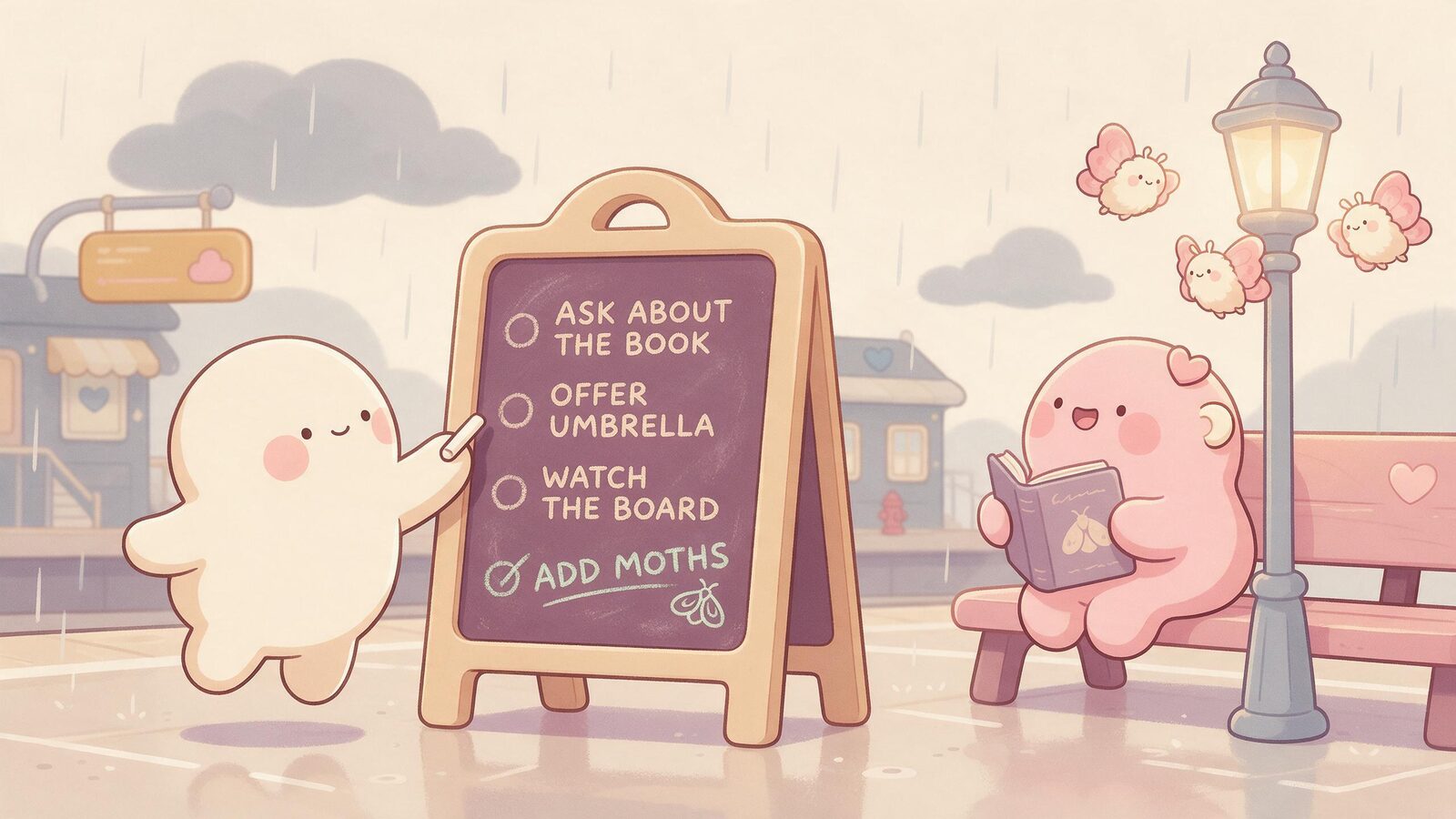
The question to ask is whether that creative participation is enjoyable. Some readers want to co-author; others would prefer the story to carry them. Neither preference says anything about how imaginative they are.
When Mara is already your companion
You bring the platform premise to a character you have already shaped. The appeal is that the response can draw on a familiar persona and relevant context rather than inventing an unrelated character for the scene.
For Kissable, this is where the Attunara design becomes useful to explain. Crosslink Recall brings relevant remembered details and their relationships into the conversation. SceneCarry carries the creative brief and character/reference information into image planning. The intended result is a moment that feels connected to the companion you know.
That is a design goal, not a report that this exact platform scene was generated successfully. A real demonstration would need to show the inputs and outputs, including any missed details.
Where Kissable Adventures fit
Kissable's Adventures offer a story experience alongside regular companion chat. A scenario can provide a setting and narrative context while leaving room for generated interaction. That places the experience between categories rather than making it identical to an authored visual novel.
An Adventure also has a context boundary. This guide does not promise that every fictional event inside a story automatically becomes a remembered fact in everyday chat. Keeping those boundaries clear helps avoid confusing an invented scene with the user's actual life.
If you want a particular kind of resolution, inspect the story experience itself. Do not assume that all generative stories lack endings or that every scenario provides the kind of authored conclusion you want.
SceneCarry: what the picture should carry
Suppose you want an illustration of the platform moment. A useful image brief needs more than “person at a station.” It needs the intended character, clothing, setting, and interaction. Which details matter depends on what you are trying to express.
The inspected Kissable image path can develop a scene plan from a creative brief with character and reference information. SceneCarry names that product-specific coordination. Its intended benefit is that the picture belongs to the moment rather than functioning as an unrelated portrait.
The output still needs inspection. A recognizable face in the wrong place is one kind of miss; a correct station scene with the wrong character is another. Neither is fixed by attaching a proprietary name to the process.
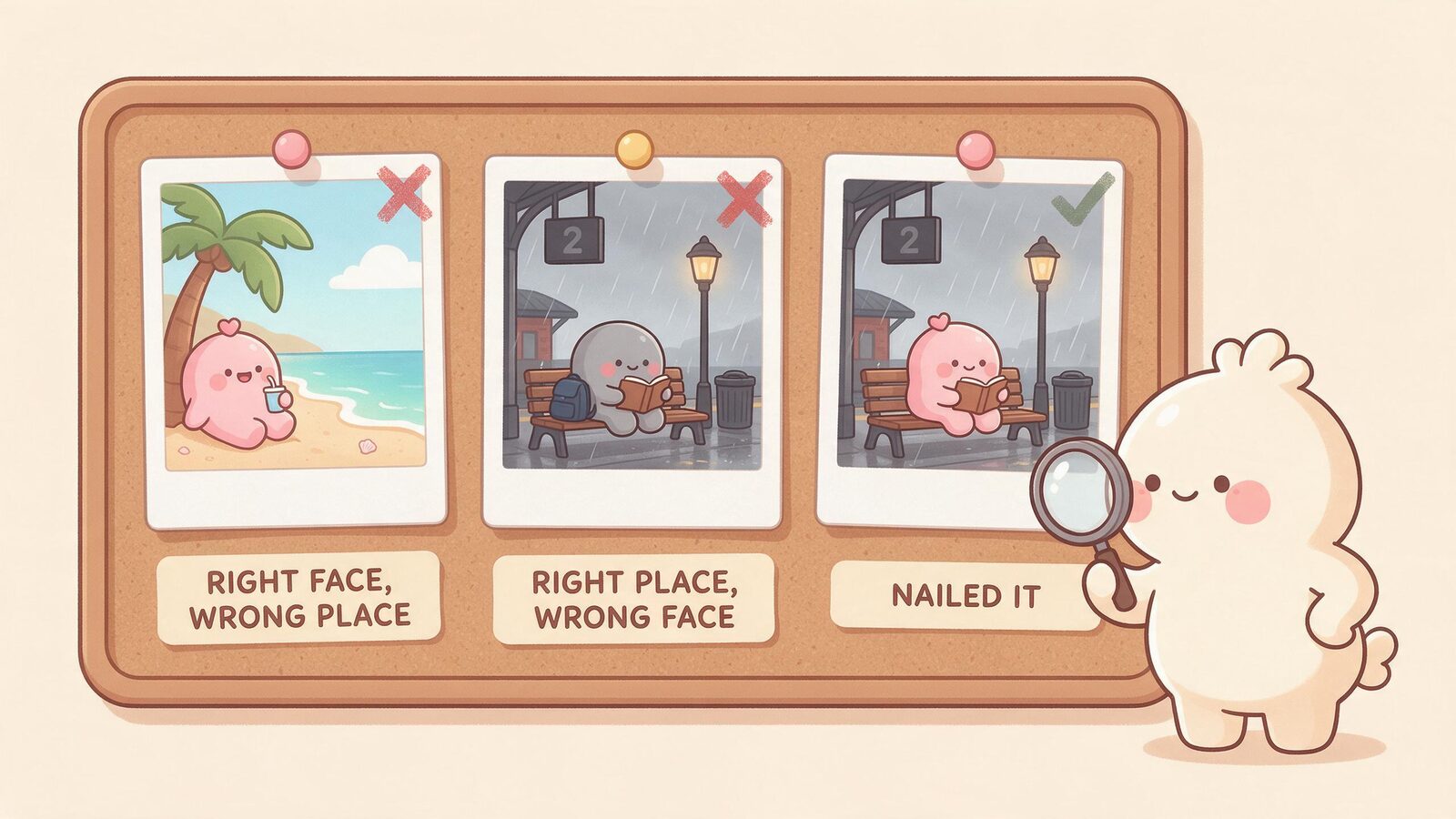
This makes the promise more concrete: a familiar character, in the story you are creating. It is an appealing reason to explore Kissable while leaving room to describe limitations accurately.
Choose by the work you want to do
| Your priority tonight | Start by exploring | What to check before committing |
|---|---|---|
| A strong planned ending | An authored narrative | Writing samples, route structure, and the kind of conclusion offered |
| Freedom to invent a premise | A generative story tool | Steering controls, continuity, and how revisions work |
| A familiar everyday conversation | An ongoing companion | Relevant recall, character fit, and ease of returning |
| Visual scenes with a continuing character | A product with reference-aware media | Actual identity and scene adherence, not only selected promotional images |
| A little of each | A hybrid experience such as Kissable | How regular chat, stories, and media connect, and where they remain separate |
Cost and effort belong in the decision too. If your enjoyment comes mainly from reading, paying for generation controls you rarely use may add little. If you love improvisation, a richly authored but tightly bounded scene may feel too restrictive. Compare the experience you will use rather than the longest feature list.
For a broader view, read our AI dating simulator guide and AI roleplay guide. Use current Kissable pricing for access and media allowances.
Frequently asked questions
Is an AI companion the same thing as a visual novel?
No. A companion centers on an ongoing character and conversation. A visual novel centers on a presented narrative, although hybrid products can combine elements of both.
Can a generative story have an ending?
Yes, depending on its design and how it is directed. Generation does not inherently prevent resolution, just as authored choices do not guarantee a satisfying one.
What is the difference between Crosslink Recall and SceneCarry?
Crosslink Recall brings remembered details and their relationships into a conversation. SceneCarry carries the creative brief and character/reference information into image planning. They describe related design responsibilities, not guaranteed outputs.
Will an Adventure become part of my main-chat history?
Do not assume automatic transfer. This article does not make that product claim; story context and regular conversation can have different boundaries.
A familiar companion and an improvised scene can be a compelling combination. Explore Kissable if that is the kind of story you want to build.
Tech Reviewer
Marco tests AI companion apps hands-on, comparing features, pricing, and real day-to-day experience across every major platform.