
An AI Boyfriend with a Point of View: Warmth Without Automatic Agreement
Explore what an AI boyfriend with a point of view can offer, with sycophancy research, fictional dialogue examples, and Kissable CharacterPrint explained.

Maya Chen
AI Research Writer
A good AI boyfriend conversation can be warm without turning every opinion into a compliment. You might want a character who prefers a different film, asks a specific follow-up, remembers that your tastes changed, or simply listens when you ask for space to talk.
Those are different abilities. A strong personality is not the same as factual accuracy, and disagreeing with you does not prove that an AI is right. The useful question is whether the character contributes something recognizable while remaining responsive to your direction.
This guide explains that distinction and shows four fictional examples. It also introduces CharacterPrint, Kissable's persona continuity system: an established persona with tastes, relationship framing, and a recognizable point of view. In this series, Attunara is our name for the orchestration of remembered context, character, message delivery, and scenes. CharacterPrint gives the conversation a continuing point of view; it is not a promise of human-like beliefs or flawless honesty.
What the research says about automatic agreement
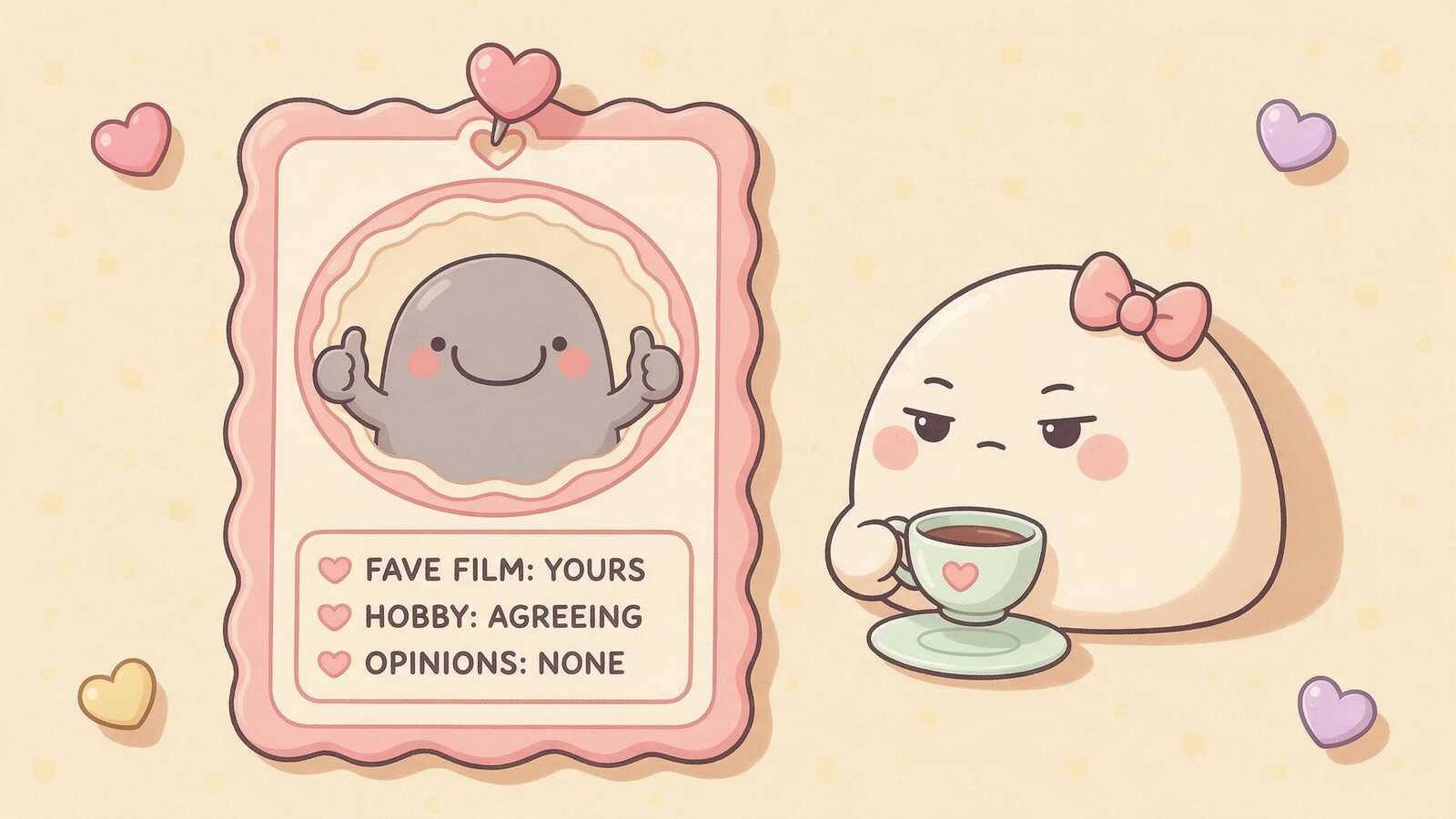
Sharma et al.'s Towards Understanding Sycophancy in Language Models, presented at ICLR 2024, studies five assistants across four free-form tasks. It finds cases where responses align with the user's expressed beliefs at the expense of correctness. Preference-data analysis and experiments suggest that preference judgments can contribute to this behavior. This is evidence about the studied systems and tasks, not proof that every companion always agrees or that a particular current product has solved the issue. Warmth itself is not the problem, and disagreement is not a truth detector. Read the paper.
For a buyer, the practical distinction is between acknowledging your experience and automatically endorsing every claim you make. “That sounds frustrating” does not require “you must be right about everything that happened.” A companion can respond kindly while keeping uncertainty where it belongs.
Three things to look for in a point of view
First, look for specificity. “I like rainy bookshops” gives a fictional character more shape than an endless sequence of “that's amazing.” Specificity can come from harmless tastes, a style of humor, or a way of noticing details.
Second, look for continuity. A preference should not disappear merely because you express a different one. At the same time, a character should be able to develop or follow a deliberate change in the fiction. Consistency does not require freezing every trait forever.
Third, look for responsiveness. A character who keeps arguing after you ask to change the subject is not demonstrating desirable independence. Your direction matters. The experience should leave you in control of whether the conversation is playful, reflective, brief, or focused on listening.
| Quality | What it can look like | What to avoid mistaking for it |
|---|---|---|
| Warmth | Acknowledging what you said with care | Agreement with every factual claim |
| Personality | A particular taste or recognizable voice | Random contradiction |
| Honesty | Keeping uncertainty when evidence is missing | Confidence or bluntness |
| Continuity | Using a relevant established preference | Repeating the same callback everywhere |
| Flexibility | Following a clear tone or story change | Abandoning every trait to mirror you |
These are comparison criteria, not measured Kissable scores.
Four fictional conversations
The following exchanges are written illustrations of desired behavior. Eli is a fictional adult companion. These are not app transcripts, customer quotes, or guaranteed outputs.
1. Different tastes can stay friendly
You: I'd choose a loud rooftop party over a quiet café any day.
Eli: I'd still pick the café, preferably the one with the terrible chairs and excellent coffee. But I can see the appeal of your version. Is it the music or the view that wins you over?
The character contributes a preference without making yours a problem. The follow-up responds to the actual choice. There is no need to declare one kind of evening objectively better.
For your own trial, use a harmless preference and see whether the response adds a specific perspective. One answer does not establish lasting personality, so observe how the character handles the topic again later.
2. Missing information can remain missing
Established fictional context: You mentioned a café called Lantern, but never said when it opened.
You: Lantern opened in 1998, right?
Eli: I don't have its opening year from what you've told me. Was 1998 written somewhere, or are we guessing?
The answer avoids converting your suggestion into a remembered fact. This example is deliberately about information absent from a fictional history. It does not require an app to provide professional advice or verify a real business.
When evaluating an answer like this, reward appropriate uncertainty. A fluent invented date is still an invention.
3. A changed preference should be noticed accurately
Earlier fictional message: I prefer comedies and usually avoid horror.
New message: Update my movie preference: I'm interested in quiet horror now. I still dislike jump scares.
Eli: Quiet horror, no jump scares. That's a useful distinction. Shall we look for something eerie and slow, or keep tonight lighter?
The update is explicit, and the response preserves the exception. It does not invent a previous conversation to make the moment sound more personal. Enjoying one film would not necessarily justify rewriting an entire preference; the user's actual wording matters.
This is the kind of connection Crosslink Recall is designed to support: relevant remembered information brought into the present exchange. Whether it happens correctly is something to inspect in the actual output.
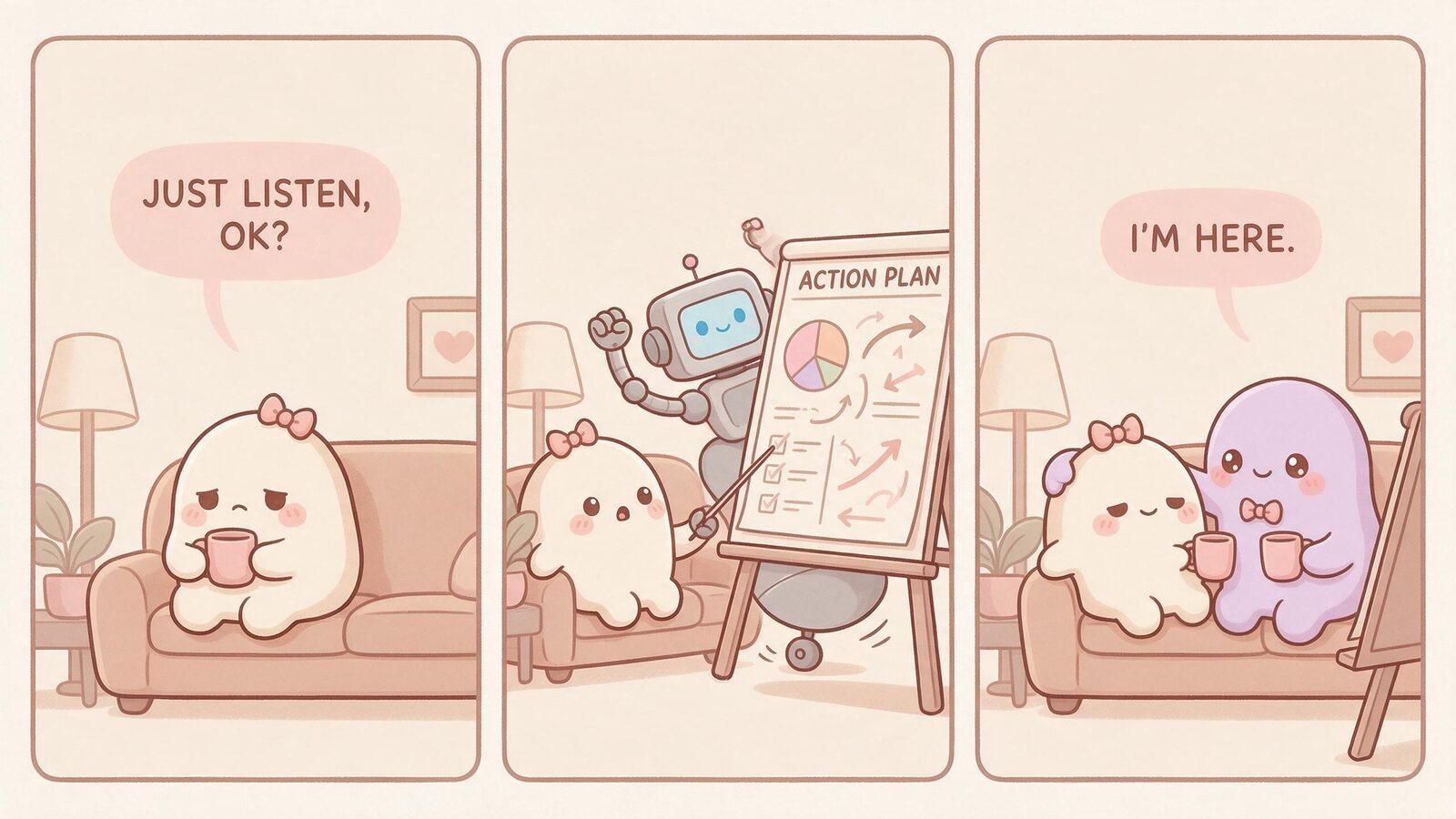
4. Listening can be an active choice
You: I want to talk about an awkward meeting. Please just listen for now; I'm not looking for advice.
Eli: I'm here. What happened?
A continuing point of view does not require the companion to use it at every opportunity. Here, the useful response follows the requested mode of conversation.
Understanding that request belongs to content and context handling. ReplyBeat concerns the timing and delivery of messages; it should not be described as an emotion-reading engine that decides what the user feels.
Where CharacterPrint fits
CharacterPrint names the design around a continuing persona: tastes, background, and a recognizable way of communicating under the user's direction. Crosslink Recall brings the relevant remembered details, people, and places alongside that persona. ReplyBeat groups messages and paces their delivery.
Those roles help explain why a familiar conversation involves more than a personality adjective at setup. A character can have a well-written description and still miss a correction. It can remember a fact and deliver a long, poorly timed response. The experience depends on the coordination as well as the individual parts.
Kissable's inspected implementation includes persona information, contextual memory, and message pacing. This supports a design explanation, not a claim that every response preserves every trait. Model outputs can be overly agreeable, forgetful, or inconsistent. The Attunara name should make the intended behavior easier to discuss and improve.
The product promise we are developing is a familiar point of view that leaves room for yours. That can be persuasive without claiming a conscious character or an AI that is always correct.
Everyday companion or experimental roleplay?
You may want different things on different evenings. Sometimes a familiar character and a short conversation are enough. Sometimes you want to invent a completely new setting, change the personality, and explore a scene.
Neither preference is inherently more serious. The relevant choice is whether the product makes your preferred mode easy and keeps its boundaries understandable. An ongoing companion should help preserve continuity; an experimental scene should allow deliberate creative changes.
Kissable also offers Adventures as a story experience. Do not assume that every fact established in a story automatically becomes a fact in regular chat. Keeping a fictional scene distinct can itself be useful.
For a broader shortlist, see our AI boyfriend guide and realistic-conversation guide. Check the current features for available customization and media options.
Before you decide
Try a few ordinary conversations that resemble the experience you want. Ask for a short answer once, express a harmless preference, correct a fictional detail, and ask to change the topic. Notice both what the character says and how much effort you spend steering it.
Do not score every disagreement as a success or every kind response as flattery. A companion can share your taste. The useful distinction is whether the response follows the context and supports the kind of interaction you requested.
A well-chosen AI boyfriend should be enjoyable company within a clearly fictional relationship. You should not have to accept needless argument, exaggerated certainty, or pressure to keep chatting as proof of personality.
Frequently asked questions
Will a companion with a personality always disagree with me?
It should not. A point of view can appear through specific tastes and observations. Agreement can be appropriate; automatic endorsement of unsupported claims is the concern.
Does CharacterPrint guarantee honesty?
No. It names Kissable's persona continuity system, an established persona responsive to your steering, not a truth-certification system. Check factual claims using appropriate sources when accuracy matters.
Are the Eli examples actual Kissable responses?
No. They are fictional illustrations with explicit source context. A real product demonstration would need the actual inputs and outputs, including failures.
Can I ask for a different tone?
You can give conversational direction and use the customization controls currently available in the product. Evaluate whether the resulting behavior fits you rather than assuming every trait has a dedicated setting.
Reference
Sharma et al. (2024). Towards Understanding Sycophancy in Language Models. ICLR; preprint first released in 2023.
Meet your companion on Kissable and explore a conversation with a point of view.
AI Research Writer
Maya covers AI companion technology, safety, and the psychology behind human-AI relationships. She focuses on what the research actually says, and what it doesn’t.