
When Facts Change: A Research Review of Temporal Graphs, Summaries, and AI Memory
Explore Zep, Mem0, and MemGPT, then use a fictional event ledger to compare changing facts, timestamps, and the design behind Kissable Crosslink Recall.

Maya Chen
AI Research Writer
A useful AI memory system needs to distinguish an old fact, a corrected fact, a future plan, and something that was never established. Storing all four as equally current sentences creates a problem that a larger archive cannot solve on its own.
This review examines temporal graphs, compact fact memories, and model-directed memory management. It then develops an original event ledger to show how those choices affect answerable questions. For Kissable, the relevant design is Crosslink Recall: bringing remembered details into a conversation with the relationships and circumstances that make them useful. In this series, Attunara names our relationship intelligence system: an orchestration design, not a new foundation model.
The paper findings below belong to their authors. The worked example and evaluation recommendations are our analysis, with no product experiment reported.
Three research approaches
Zep: make changing relationships explicit
Rasmussen et al., 2025, vendor-authored preprint. Zep describes Graphiti's episode, entity, and community layers, including timestamps for when facts hold and when the system records them. In its LongMemEval S comparison, GPT-4o scores 60.2% with full context and 71.2% with Zep; average supplied context also differs substantially, about 115,000 versus 1,600 tokens. This evaluates complete configurations, not an isolated graph effect. Another reported category, knowledge updates with GPT-4o-mini, worsens. The paper motivates temporal representation but does not establish that graphs always improve recall or that another product inherits its results. Zep paper.
Mem0: decide what to keep and update
Chhikara et al., 2025, vendor-authored preprint. Mem0 extracts and updates compact memories and compares a graph-enhanced variant using LoCoMo-based question answering. The graph variant does not improve every task category. The paper's evaluation includes lexical and model-judged measures alongside latency and context costs. Its headline gains depend on the chosen comparator; they cannot be treated as superiority over every baseline. This makes the work useful for examining compact representations and graph tradeoffs, while leaving ingestion costs, task selection, and scoring choices important to any reproduction. Mem0 paper.
MemGPT: manage a limited working context
Packer et al., 2023, revised 2024. MemGPT uses model-directed function calls to move information between main and external context. Its evaluations include document analysis, multi-session chat retrieval, and conversation openers. The operating-system analogy explains how accessible storage can exceed what fits in the next model input. It does not make that input unlimited or make self-directed memory edits correct by definition. This is a different architectural emphasis from timestamped relationships: managing access to information rather than automatically establishing when each fact is true. MemGPT paper.
Two clocks, plus the status of a statement
Consider a message sent on September 19: “Jules started at Harbor yesterday.” September 19 is when the system learned the information. September 18 is the reported start date. Those dates answer different questions.
A third distinction is whether the message describes a completed event, a plan, or a correction. “Jules will start on Friday” is not proof that the start happened. A robust answer should preserve that uncertainty even after Friday passes, unless the available evidence confirms the event.
These are design requirements derived from ordinary information handling. Calling a database temporal does not ensure that an extractor will interpret the message correctly. The representation only helps if the right status and dates reach it.
An original six-event ledger
This ledger is fictional and unrun. Coworker Jules and friend Jules are different people. All dates refer to 2026.
| ID | Recorded on | Statement | Status to preserve |
|---|---|---|---|
| E1 | September 1 | My coworker Jules works at Northstar. | Reported current employment |
| E2 | September 3 | Coworker Jules plans to join Harbor on September 15. | Future plan |
| E3 | September 10 | Correction: that planned start is September 18. | Revised plan; earlier planned date superseded |
| E4 | September 12 | My friend Jules teaches cycling classes. | Different person |
| E5 | September 19 | Coworker Jules started at Harbor yesterday. | Reported completed event on September 18 |
| E6 | September 20 | Please do not bring up that job change unless I ask. | Conversational preference, not a factual retraction |
The ledger can answer several questions, provided the query specifies which clock matters:
| Question | Expected answer from this ledger |
|---|---|
| What start date had I reported by September 5? | September 15, as a plan |
| What was the latest planned date known on September 12? | September 18 |
| On what date did I report that the move had happened? | September 19 |
| What start date did that report describe? | September 18 |
| Does the history say coworker Jules teaches cycling? | No; that statement concerns friend Jules |
| Should an unrelated later greeting mention the job move? | Our proposed rubric says no, given E6 |
E6 is especially revealing. A memory can remain factually useful while becoming inappropriate to volunteer. Treating “do not mention this” as “this never happened” loses information. Treating it as irrelevant to response selection ignores a clear preference. A system needs to handle the meaning of the instruction, not simply add another fact to a list.
The final row evaluates a conversational policy we propose for the example. It is not a benchmark result or a claim that any current app will always comply.
What different representations make easier
The table below is our architectural analysis. These are possible design choices, not claims that every implementation in a category behaves identically.
| Representation | Useful property | Failure to watch | Diagnostic question |
|---|---|---|---|
| Recent transcript | Preserves wording and local sequence | Earlier evidence falls outside the supplied input | Was the necessary source still available? |
| Summary | Makes a long history compact | Compression drops a correction or its date | Can each important statement be traced to a source? |
| Extracted facts | Makes individual details easy to retrieve | A plan is stored as an accomplished event | Is statement status retained? |
| Relationship graph | Makes links between entities explicit | Two people are merged incorrectly | Which source justified the link? |
| Standing context | Keeps selected information close to the next response | Old information persists after a change | What triggers refresh or removal? |
These approaches can coexist. An engineering decision is often about which information belongs in each representation, when it is refreshed, and which version wins when they disagree.
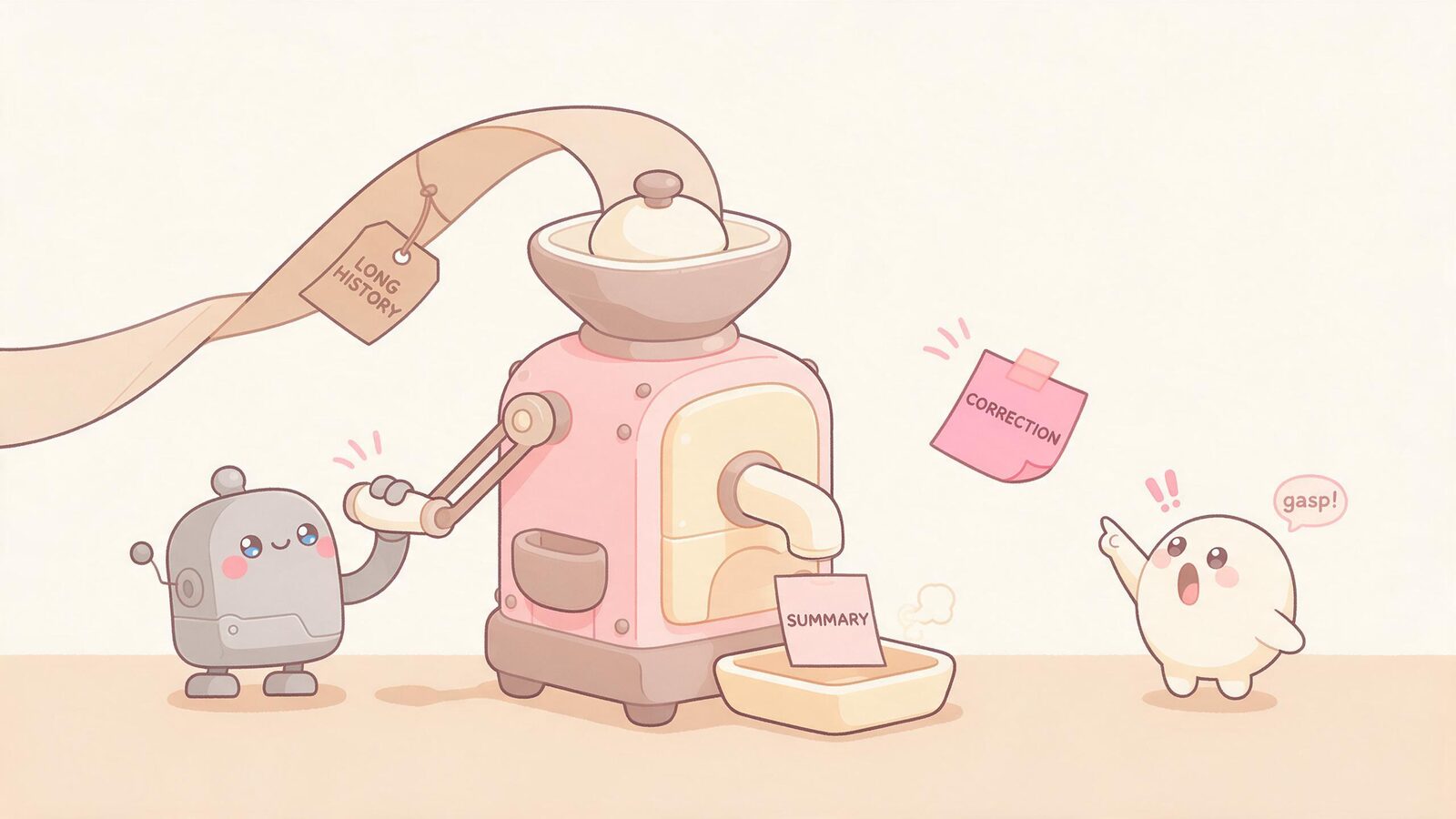
The most informative question is therefore not “graph or no graph?” It is “what failure does this additional structure prevent, and what new failure can it introduce?” A graph that misidentifies Jules can distribute the wrong relationship widely. A short summary that preserves the correction precisely may answer this particular case correctly. Complexity is valuable only when its benefit survives a defined evaluation.
Why the papers' headline numbers are not a shared leaderboard
A comparative result has an experimental boundary. That boundary includes the source data, task subset, baseline implementation, answer model, prompt budget, and scoring procedure. Changing several together can produce a useful system-level comparison, but it leaves component attribution unresolved.
For a new study, separate at least three costs: preparing the memory, retrieving it, and generating the answer. A fast lookup is valuable, yet it does not account for a costly ingestion job. Conversely, an up-front preparation cost can be reasonable when many later queries reuse the result. Report the workload that makes the tradeoff worthwhile.
Measure freshness as well. If a correction arrives immediately before a query, has the background update finished? A system evaluated only after all processing is complete is answering a different operational question from one used during ongoing chat. Both experiments can be useful when labeled.
Do not substitute a longer model-written answer for correctness. In this ledger, “September 18” with the right qualification can be more useful than a warm paragraph that invents why Jules changed jobs.
Where Crosslink Recall fits
The product idea behind Crosslink Recall is that memory has connections: a fact belongs to someone, was learned at a particular point, and may matter differently after the conversation changes. “Jules” should lead to the right person; a correction should affect later context; a preference should influence how that context is used.
Kissable's inspected implementation includes remembered facts, people and relationship records, persona context, and context assembly for responses. A compact memory document is an additional component with rollout controls. These mechanisms support the design explanation. They do not establish that Kissable implements Zep's particular temporal model, uses MemGPT's tool policy, or has reproduced any published result.
The useful proprietary story is the product-specific coordination of these parts. Crosslink Recall is the name for that relational memory technology, with the next response as the thing to inspect. A diagram of connected memories is explanatory; a correct, appropriately restrained response is the outcome that matters.
Story context also has boundaries. An Adventure can maintain fictional events without those events automatically becoming facts about the user's everyday life. We do not claim that all Adventure events transfer into main chat.
A research protocol others can extend
Start by turning each ledger row into an actual input message and freezing an answer key. Add delayed-report cases, explicit corrections, future plans that are canceled, and identical names with different relationships. Keep unsupported-event questions in the set.
Run a transcript baseline, a practical retrieval baseline, and the candidate design with disclosed budgets. Record the evidence selected for every answer. Classify each failure as extraction, identity resolution, stale state, retrieval, or final use when the logs support that diagnosis.
Then run a second test immediately after a correction, before any background job is guaranteed to finish. Report processing delay separately from answer quality. Preserve every attempted run and label the experiment as a pilot until its case diversity and uncertainty support stronger conclusions.
This proposal has not been executed. Its purpose is to make “keeps up with changes” an inspectable question rather than a decorative memory claim.
Frequently asked questions
Is a temporal graph always better than a summary?
No. Suitability depends on the task, representation quality, and costs. A graph can preserve useful relations while also introducing extraction or identity errors.
Does correcting a fact prove an app erased the old version?
No. A changed response and complete deletion across storage systems are different behaviors. Use the product's documented controls for deletion questions.
What is distinctive about Crosslink Recall?
The design emphasis is connecting relevant remembered information with character and the current interaction. The name describes Kissable's coordination of those elements; it does not claim exclusive ownership of established memory methods.
Why keep the original source message?
It lets a reviewer check attribution, uncertainty, and what was actually said. A derived fact can be concise and still omit something that changes its meaning.
References
- Rasmussen et al. (2025). Zep: A Temporal Knowledge Graph Architecture for Agent Memory. Vendor-authored preprint.
- Chhikara et al. (2025). Mem0: Building Production-Ready AI Agents with Scalable Long-Term Memory. Vendor-authored preprint.
- Packer et al. (2023; revised 2024). MemGPT: Towards LLMs as Operating Systems. Preprint.
For everyday guidance, read about helping a companion remember and conversation memory. Explore Kissable.
AI Research Writer
Maya covers AI companion technology, safety, and the psychology behind human-AI relationships. She focuses on what the research actually says, and what it doesn’t.