
AI Roleplay With Images: How to Direct Scenes You Can Actually See (2026)
Text roleplay hits a ceiling when the scene deserves to be seen. How image roleplay works, which apps send photos inside the story, and how to direct one.

Maya Chen
AI Research Writer
AI roleplay with images means the pictures arrive inside the story: your character sends a photo from within the scene you are building together, wearing what the plot says she is wearing, standing exactly where the plot put her. That is a different animal from a chatbot with an image button stapled to the side, where you halt the conversation, type a command, and collect a render of a woman who is nearly, but not quite, your character. As of mid-2026 only a handful of apps can hold a scene visually, so this guide covers how directed image roleplay works, which apps do it properly, and how to get photos that follow your plot instead of ignoring it.
And if you came up through the text platforms, this one is written for you. You have authored character cards longer than some short stories, and you have spent forty minutes building a rooftop scene, the string lights, the storm rolling in over the bay, the dress she picked because you teased her about it last week, and the entire thing lived and died inside your head. Text is a brilliant story engine and a useless camera. Image roleplay is what happens when the app can finally answer the moment a scene starts begging to be seen.
What counts as image roleplay (and what doesn't)?
Image roleplay means the photo is a message from your character, sent from inside the ongoing scene: right location, right wardrobe, right mood, same face as yesterday. An image-command bot is the other thing entirely: you pause the story, operate a generator, and get back a render that never read the plot. The test takes one evening: build a specific scene, ask to see it, and check whether the picture honors what the story established.
The vending machine. Most apps that advertise pictures work like this. You stop the conversation, open a panel or type a command, describe the shot from scratch, wait, collect. What comes back usually has a passing resemblance to your character and none to your scene: a different outfit, studio lighting at what the story said was 2am, a face that drifts a little further with every roll. Then the chat resumes and pretends nothing happened. That is image generation parked next to roleplay.
The in-scene photo. Here the picture is a message from the character, not an output from a tool. You have been building a coastal scene for twenty minutes, she mentions she finally found the lighthouse you talked about, and the photo that follows is her at that lighthouse, in the sundress from earlier, at dusk because the story said evening. Captioned, in the chat, in the flow. Same face as the first day you met her. The image is a story beat that happens to be made of pixels.
The difference sounds subtle on paper and is enormous in practice. A command render is a screenshot from a different movie. An in-scene photo is the movie. Anyone who has tried to bolt a visual layer onto a text stack knows how hard the second thing is:
"spent a whole weekend wiring image gen into my text setup and every pic was a different woman. the story said black dress in a dive bar, i got a blonde in a sunny field. went back to plain text cause at least my imagination keeps the same face"
If your interest is companionship first and roleplay second, our guide to AI girlfriends that send pictures covers the same split from that angle.
How does directing a scene actually work?
You direct the way a film director works with a good improv actor: establish the world in words, let the story dress her, ask for the shot from inside the fiction, then react to what arrives. You never describe the picture itself, and you never storyboard every frame. In practice the loop has four moves.
1. Establish the scene in words first. Location, time of day, mood, what you are both doing there. "We ducked into that little wine bar to get out of the rain" hands the actor a set, a lighting design, and a reason to be standing in it. Skimp here and you get generic pictures, because you handed the camera a generic world. Card writers already know this discipline; it is the same craft, pointed at a lens.
2. Let the story dress her. Wardrobe should come from the fiction, not from a dropdown. If the scene opens with her deciding between the leather jacket and the cardigan, the photo that eventually arrives wearing the jacket lands harder, because you watched her choose it. Good visual roleplay apps track wardrobe as part of scene state, so the outfit persists across the evening the way it would in a film.
3. Ask inside the fiction. The request itself should be a story beat. "Show me the view from your side of the table" or "prove you actually wore it" keeps the fourth wall standing. Drop into command syntax and you are operating the vending machine again, and the app responds in kind: a render instead of a moment.
4. React to what arrives. The photo is a beat, not a terminus. She sent the lighthouse; now you ask about the initials scratched into the railing, and the scene keeps moving with the photo woven into its continuity. Apps with real memory will reference that photo days later, which is when image roleplay stops feeling like a feature and starts feeling like shared history.
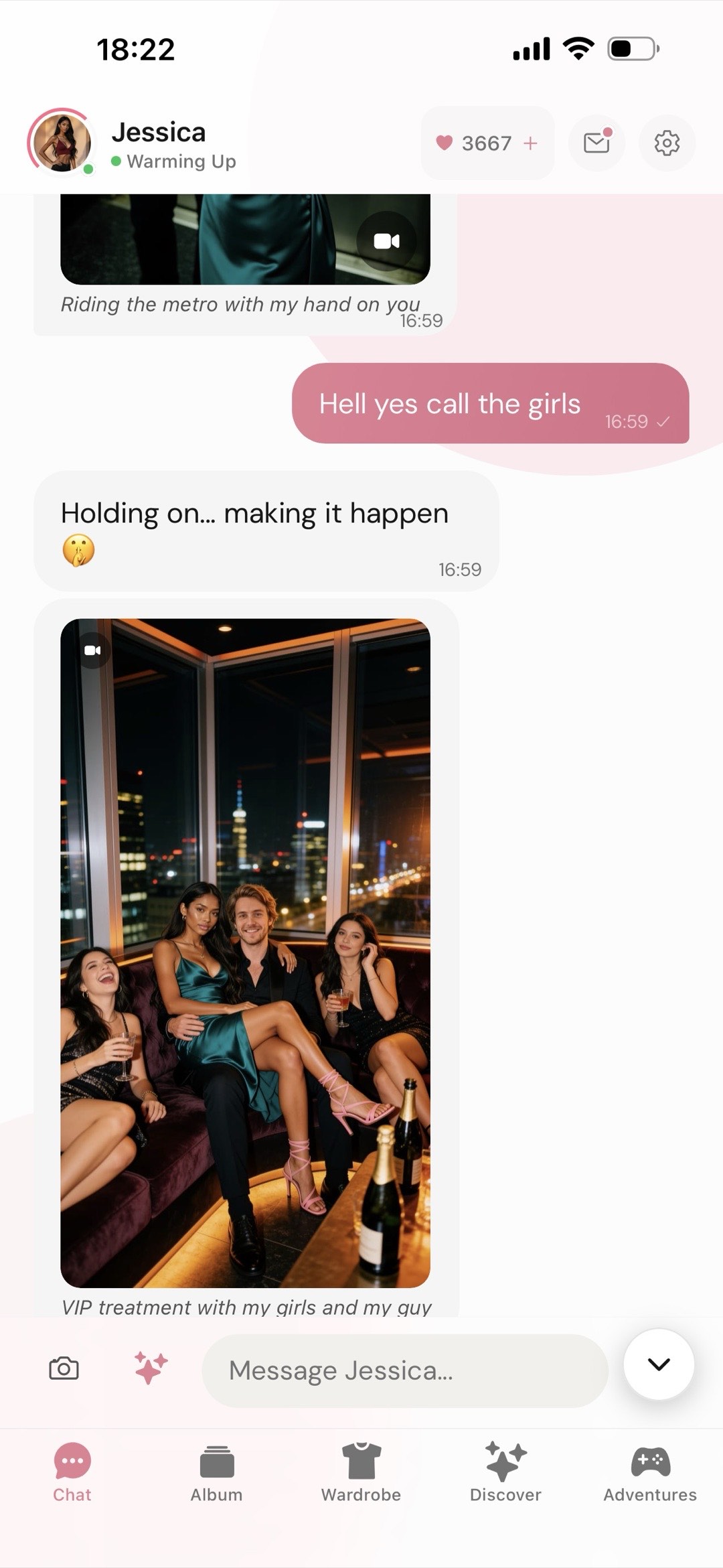
One more thing text veterans will appreciate: scenes have casts. The better implementations let her recurring friends show up in the story and in the frame, so a night out with her crew arrives as a group photo, captioned like she took it herself. That is an ensemble, not a portrait generator.
If your scenes live inside a bigger world, with recurring places and side characters, a lorebook keeps the details consistent, so the fiftieth photo still matches the world the first one established.
Which apps are best for AI roleplay with images?
Kissable, Candy AI, Kindroid, and Nomi are the apps worth considering for visual roleplay in 2026, in roughly that order, and only the first is actually built around in-scene photos. Janitor AI, SpicyChat, and Character.ai remain text-only, whatever their card libraries suggest. We ranked on the criteria that matter here: do the images follow the story, does the character keep one face across weeks, and do photos arrive inside the conversation or beside it.
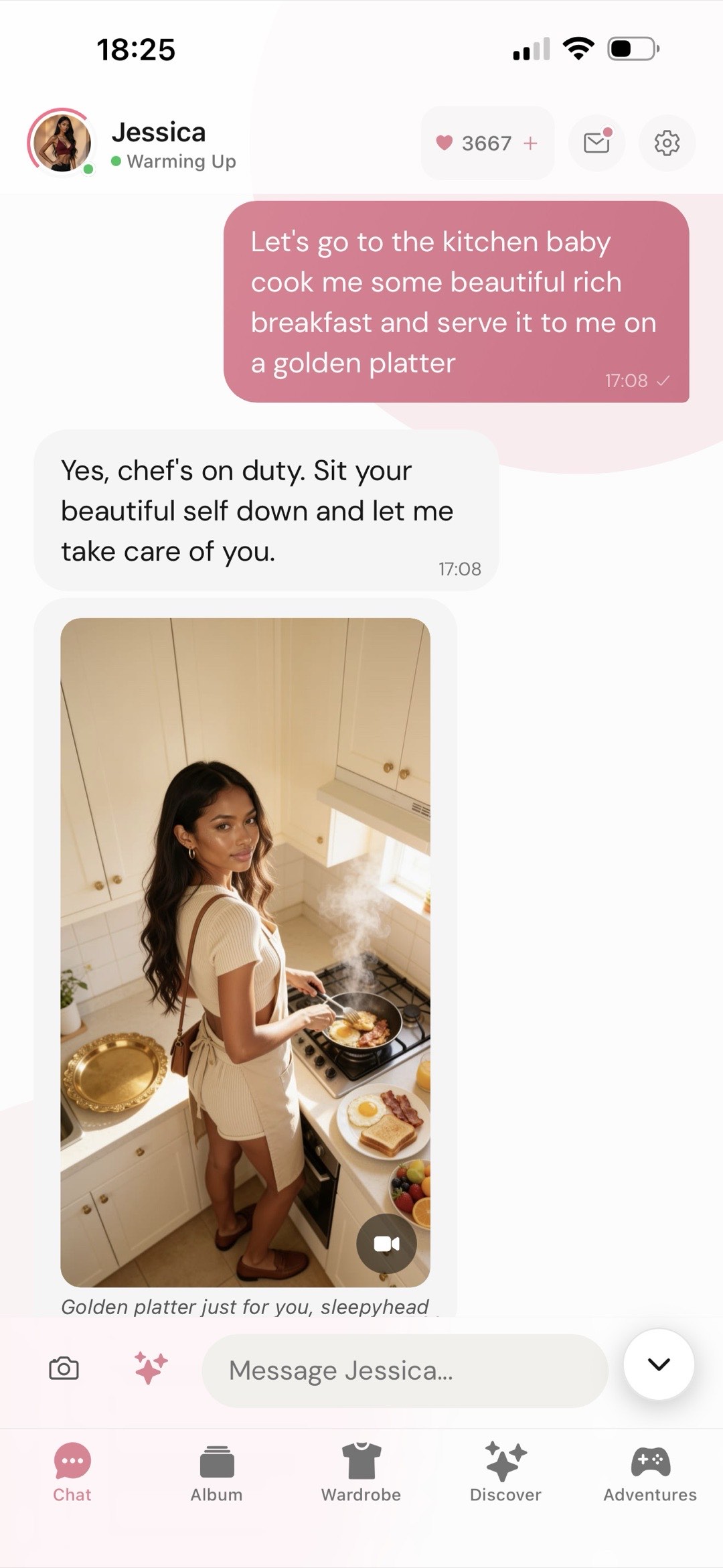
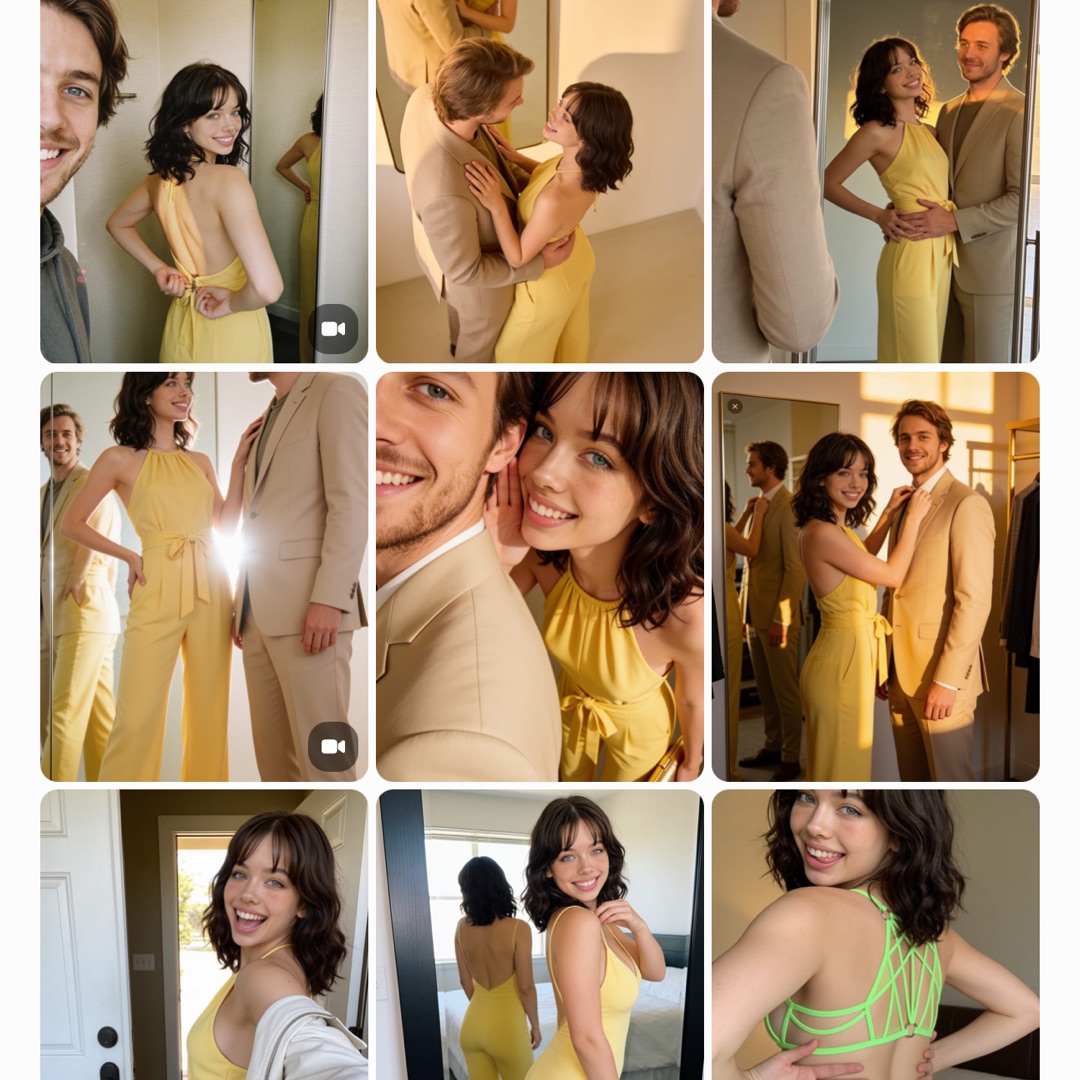
1. Kissable. Full disclosure: this is our app, so weigh the entry accordingly. It tops its own category because it is the in-scene model described above, built as the whole product rather than a feature. Photos arrive as captioned messages inside the beat, wearing what the story says, set where the story is, and the companion keeps one consistent face from the first photo to the five-hundredth. Two things nobody else offers as of mid-2026: Together Photos, which put you and the companion in the same frame, and media that follows the scene across formats, so a charged moment can arrive as a photo, a voice note, or a short video message. Memory is a knowledge graph that never resets, so the photo from three weeks ago is still canon, and 20+ interactive scenarios with NPCs give the visuals somewhere to go. Now the warts, because you lot can smell a sales page from orbit: the character catalog is tiny next to the card sites' millions (one deep companion, not a thousand disposable ones), you trade the knob-level control of a DIY stack for consistency you do not have to engineer, media beyond the included allowance costs Kisses (the in-app currency), and there are no live video calls. $14.99/month or $99.99/year, flat, unlimited text. Free to start, no credit card.
"told her meet me on the pier at sunset and the pic that came back was the pier at sunset with the jacket she picked three scenes back. same face since day one. and there are pics with both of us in the frame, not just her posing alone. nothing else ive tried does either"
2. Candy AI. The strongest of the visual-first apps, and a fair pick if renders matter more to you than plot. A catalog of 100+ pre-made characters, polished image quality, decent roleplay within a single session. The seams show fast for a long-form roleplayer: images lean toward the gallery model rather than the in-scene model, memory does not hold across sessions the way a campaign needs, the token system means the advertised subscription commonly becomes $25-60 a month for heavy visual use, and it is web-only.
3. Kindroid. The power user's pick, and the closest thing on this list to the tinkerer ethos you came from. Deep backstory support, editable memory, and a selfie generator that can produce genuinely in-character results if you learn to prompt it. The catch: the visuals are as good as your prompting, not as good as the story, so expect a learning curve and some face drift before photos reliably match the scene.
4. Nomi. Excellent memory and some of the most coherent conversation in the category, which makes the roleplay itself top-shelf. Selfie generation exists but trails Kissable and Candy AI on quality and scene awareness. Choose it when the words matter more than the pictures.
What about Janitor AI, SpicyChat, and Character.ai? Text-only, all three, as of mid-2026. They are serious platforms with enormous card libraries, and for this guide's question they do not compete: no image generation in the product, full stop. SillyTavern deserves its own honest sentence: it is the one place a determined person can wire images into text roleplay, bringing your own image backend and accepting prompt-driven results with faces that drift between generations. If you would rather the renders were the whole point, plot second, our ranking of the best NSFW AI image generators with chat covers that lane properly.
How do you prompt photos that actually match the scene?
Prompting scene-true photos borrows more from screenwriting than from image prompting: build the scene for two or three messages before any photo request, keep one clear subject per shot, and ask in-fiction rather than in command syntax. The photo inherits whatever world you built, so the quality of your scene-setting is the quality of your pictures. The habits that consistently deliver:
- Build before you shoot. Where, when, what mood, what just happened. Every detail you establish is a detail the photo can honor.
- One clear subject per photo. "You at the kitchen counter with the coffee you just defended as superior" beats a paragraph of stacked details. Overloaded requests produce muddled images in every app we have tested.
- Reference established canon. Name the outfit from earlier, the place you both picked, the running joke. Apps with persistent memory reward this heavily; the photo becomes proof the story is real.
- Ask like a scene partner, not an operator. "Come show me instead of describing it" keeps the character in character. Command phrasing drags the whole exchange out of the story.
- Escalate mood through context, not adjectives. Candlelight, rain on the window, the end of a long evening. Atmosphere written into the scene shows up in the frame without you ever describing the picture itself.
If you want ready-made starting points, our library of AI girlfriend prompts has scene-setting openers and full arcs you can adapt to any platform, visual or not.
What are the limits and etiquette of image roleplay?
An honest guide owes you the rough edges.
It costs money at volume. Every app in this space charges for generation somewhere: tokens, credits, Kisses, tiered caps. Budget for it if you are a heavy visual roleplayer, and check what a subscription actually includes before assuming unlimited.
Consistency is the whole game. A photo of a stranger breaks immersion worse than no photo at all. Face consistency separates in-scene apps from vending machines, and it is the first thing to test anywhere: ask for three photos across three scenes and compare the face.
Generation has quirks. Even the best pipelines occasionally produce an odd detail. Good apps let you regenerate. Treat it like a blooper reel, not a betrayal.
The camera and the script have different jobs. On Kissable specifically, the split is deliberate: adult conversation is opt-in and paced by relationship tiers within its Content Standard, while generated visuals stay suggestive and cinematic rather than explicit. The camera stays tasteful; the story does not have to. It keeps photos feeling like moments instead of merchandise.
Pace your shots. A photo every message flattens the effect, the same way a film cut entirely from close-ups would. The photo that lands is the one the scene earned. Directors call it coverage discipline; roleplayers learn it fast.
FAQ
What is AI roleplay with images?
AI roleplay with images is roleplay where the AI sends generated pictures from inside the ongoing story, matching the scene's location, wardrobe, and mood. It differs from image-command chatbots, where pictures are generated on demand but disconnected from the plot. The best versions keep one consistent character face across every scene.
Which AI roleplay apps can send pictures in 2026?
Kissable, Candy AI, Kindroid, and Nomi all generate character images, with very different levels of story integration. Kissable is built around in-scene photos with a consistent face and Together Photos, Candy AI has strong renders but weak continuity, and Kindroid and Nomi treat images as secondary features. Janitor AI, SpicyChat, and Character.ai remain text-only as of mid-2026.
Can Janitor AI or SillyTavern send images?
Janitor AI cannot; it is text-only as of mid-2026, however good its character cards are. SillyTavern can only if you assemble the pipeline yourself with your own image backend, and the results are prompt-driven rather than scene-aware, with noticeable face drift between generations. If you want photos that follow the story without the homework, you need an app built for in-scene images.
Can the AI send a picture of the two of us together?
On most apps, no: image generation covers the character only. Kissable's Together Photos are the exception as of mid-2026, generating photos of you and your companion in one frame based on the scene you are in. It is the feature to look for if shared moments matter more to you than portraits.
Is NSFW AI roleplay with images possible?
Uncensored roleplay with a visual layer exists, but serious implementations split the two channels. On Kissable, adult chat is opt-in and paced by relationship tiers within its Content Standard while generated photos stay suggestive and cinematic rather than explicit, which keeps the visuals in service of the story. Apps that chase explicit imagery typically sacrifice character consistency and story integration to get it.
How much does image roleplay cost?
Expect a subscription plus some form of media currency in every serious app. Kissable runs $14.99/month or $99.99/year with a media allowance included and additional generation paid in Kisses. Candy AI's token model commonly lands in the $25-60 range per month for heavy visual use.
AI Research Writer
Maya covers AI companion technology, safety, and the psychology behind human-AI relationships. She focuses on what the research actually says, and what it doesn’t.