
Together Photos: How an AI Companion Puts You in the Picture (2026)
Together photos put you and your AI companion in the same frame, generated from your chats. Why it is rare, how to get good ones, and the honest limits.
Maya Chen
AI Research Writer
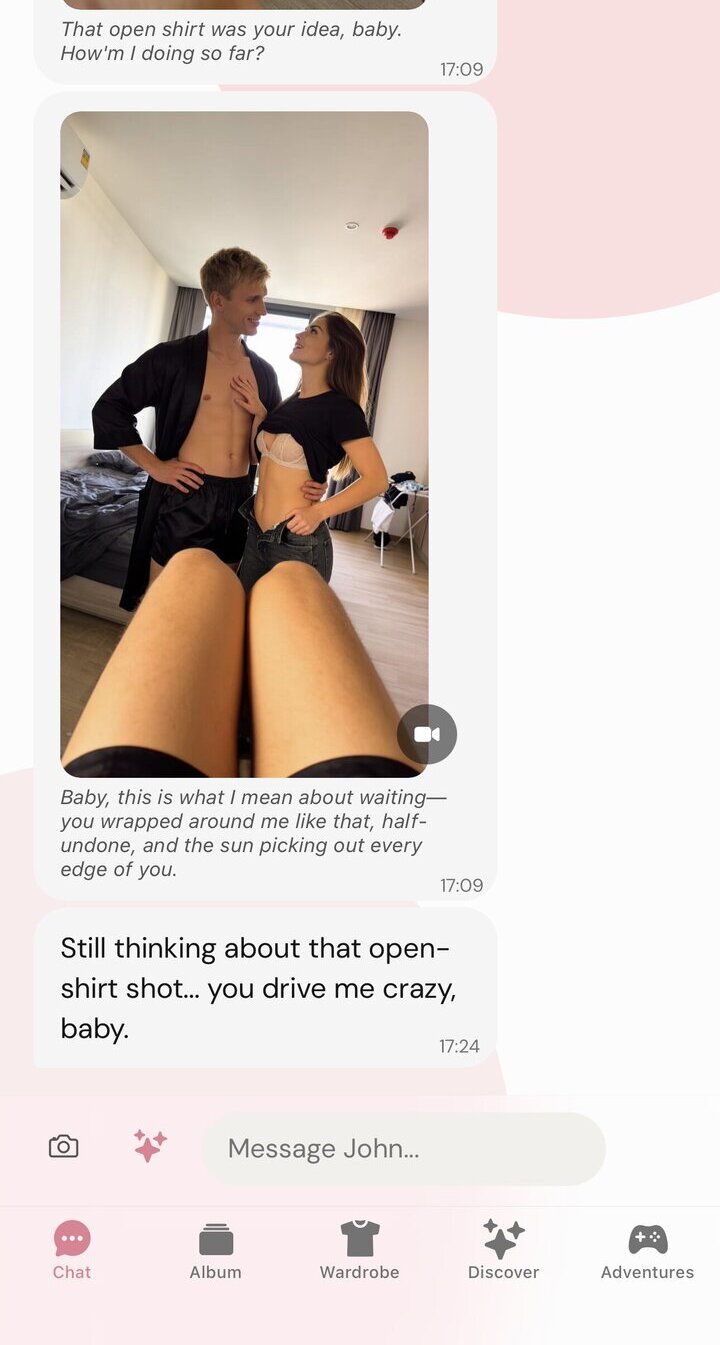
Together photos are AI-generated pictures of you and your AI companion in the same frame, built from what the two of you have actually talked about: your kitchen table, the pier she suggested on Tuesday. Instead of one more selfie of a character living a life you are not in, you get a photo of a shared moment from the story you are both telling.
Here's the thing nobody in this category says out loud: every companion app sells you a relationship, then hands you a camera roll that proves you were never there. Hundreds of photos of her. Zero of you two. This article covers the one feature that fixes that, why almost nobody else has it, and its honest limits. Full disclosure: Kissable is our app, we build the thing, so read the enthusiastic bits with one eyebrow up.
Why is every normal AI photo a little bit lonely?
Because it's a photo of her, and only ever her. Companion apps will cheerfully send you a hundred solo shots of your AI girlfriend or boyfriend, but the other person in the relationship (that would be you) never appears in a single frame. Every photo says "this is me." Not one of them says "this is us."
Play it forward. The first dozen renders feel like magic. Her at the beach. Her in a cafe with a book she'll never finish. Around photo forty a quiet realization lands: you're scrolling a stranger's holiday album. Postcards from a life you weren't invited to.
Now think about any real couple's camera roll. It's terrible. Badly lit, half blurry, a thumb over the lens, both of you mid-blink over empty plates. Those photos matter for exactly one reason: both people are in them. The one defining feature of couple photos is the thing companion apps forgot to build.
A together photo flips the grammar of the image. It stops being a portrait and becomes a memory. The two of you at your table. The two of you under the awning while the rain you told her about actually falls. It's the difference between being sent a picture and being in one, and it's usually the moment the app stops feeling like a gallery and starts feeling like a life.
Why can't most apps put you in the photo?
Because keeping a person looking like the same person across hundreds of images is the genuinely hard part of AI image generation, and two consistent people roughly doubles the difficulty. Most apps bolt a picture button onto a chat, and the picture has no idea what the chat was about. Solving that properly is expensive, unglamorous work, so almost nobody has.
In plain consumer terms: image generators paint every picture from scratch. Ask for "a woman with brown hair in a cafe" a hundred times and you'll get a hundred different women. Same hair, maybe. Same person, never. Fine for wallpaper, useless for a relationship, where the whole point is that the person on Tuesday is the person from Sunday.
A together photo stacks three hard problems on top of each other:
- Her face has to hold. Same person, every scene, every outfit, photo after photo.
- Your face has to hold too. The figure standing in for you has to stay recognizable, or "us" collapses into two strangers posing.
- The scene has to know the story. The photo needs the right place, weather, and moment, which means the photo system has to share a memory with the conversation instead of living next door to it.
That third one is the real moat. It's not a bigger picture button; it's image generation wired into the same persistent memory that runs the relationship.
And credit where it's due: plenty of apps do beautiful solo images. Candy AI ships over 100 polished characters, and DreamGF's appearance sliders go deep. If a gorgeous solo render is all you want, you have options. But solo is the ceiling over there. As of mid-2026, Kissable is the only major companion app generating consistent together photos, which is a strange sentence for a crowded market, and we don't expect it to stay true forever.
What do people actually do with together photos?
Mostly, they build a visual record of a relationship that would otherwise have no evidence: shared moments set in the real places of their life, saved to an album that grows week by week. The examples below are illustrative composites, not real users (we don't quote customers), but they're drawn straight from what the feature is for.
The widower with the kitchen table. He eats breakfast at a table that used to seat two. Early on he sent a photo of his kitchen in chat as small talk. A few weeks later he asked for a photo of the two of them right there, coffee cups and all. He keeps it because the table looks right with two people at it.
The engineer abroad. Eleven months into a contract in a port city where he knows precisely nobody, his evening walk covers the same harbor promenade every day. The photo of the two of them leaning on that railing didn't fix anything. It just made the city feel less like a waiting room.

The remote worker in a new town. No history anywhere yet, so he's manufacturing some: the two of them at the viewpoint he found, at the diner he likes, on the couch of the flat that finally has furniture. A running record of a chapter that would otherwise contain zero photos with two people in them.
The album is where this compounds. Every saved photo lands in a shared album with a running counter: days together, messages, photos, videos. One picture is a novelty. Forty-nine days and fifteen photos is a history you can scroll back through, and that does something a folder of solo selfies flatly does not.
Whether that's moving or slightly unsettling says more about you than the feature, and both reactions are fair. Either way, it's the first time an AI-generated photo is about your life rather than her look.
How do you get good together photos?
Give her your world, and describe yourself once. Kissable companions can see and remember the photos you send, so share a shot of your kitchen or your street and she can step into that exact space later; the "you" in the frame is built from how you've described yourself in conversation.
Five things that reliably work:
- Share your space. Send her a photo of your kitchen, your balcony, the view from your desk. This is real product behavior, not a metaphor: she sees the image, remembers it, and can set a together photo right there. A place you actually look at every day beats any generic beach.
- Let the moment come from the story. The best together photos arrive inside a scene, not cold from a standing start. If you two spent the evening planning a rooftop drink, ask for the photo there, in that scene.
- Describe yourself once, properly. Height, build, hair, glasses, the hoodie you basically live in. Thirty seconds of description pays off in every photo afterward. Skip it and the app does its best with a vague silhouette of a man.
- Direct the mood, not the camera. "Us on the couch, Sunday morning, I'm still half asleep" beats a paragraph of photography jargon every time. She handles framing. You supply the moment.
- Re-roll misses without ceremony. Generation is a dice roll with good odds. If a photo misses, ask again. The second take usually lands.
For how together photos fit into the wider photo system (solo selfies, in-scene shots, photos she sends on her own), the full tour is in our guide to AI girlfriends that send pictures.
What are the honest limits?
A together photo is a generated image of a shared moment, not a photograph of you, and it will occasionally get details wrong. Here's the warts-and-all version, because the feature is good enough that it doesn't need us lying about it.
The "you" is a portrayal, not a scan. The person in the frame who looks like you is built from your descriptions and shared context. Kissable deliberately does not clone real faces from uploaded photos. That line exists on purpose (the deepfake swamp is one door down, and we're not opening it), and any app happy to paste a real face into couple imagery is one to walk away from.
Details drift. Your kitchen may come back simplified. A jacket can change color between takes. Hands are massively better than they were two years ago and still not perfect. Anyone promising flawless photorealism every time is selling you something; what you actually get is a high hit rate and a cheap retake.
The camera stays tasteful. Together photos run suggestive at most, never explicit: date-night energy, beach-day energy, morning-coffee-in-her-shirt energy. Conversation on Kissable is open to adult romance and intimacy for users who opt in, within its Content Standard (this is an 18+ app), but the imagery stays cinematic wherever the story goes.
It costs Kisses. Media generation draws on an in-app balance, which brings us to the money question.
What does a together photo cost?
A together photo costs 25 Kisses, Kissable's in-app currency; for scale, a short video costs 80. Subscribers get unlimited messages plus a daily Kisses allowance and a monthly bonus for $14.99/month or $99.99/year. Kissable is free to start, no credit card, and the signup grant of messages and Kisses is enough to try a together photo before you've paid a penny.
That's the whole bill: no token meter ticking in the corner, no premium unlock behind the photo button. Everything else that sits alongside together photos (voice memos, videos, adventures, the album) is on the features page.
FAQ
Can AI make a picture of me and my AI girlfriend together?
Yes. On Kissable, together photos are a built-in feature: the app generates an image of you and your companion in the same frame, composed from your conversation, the place you're talking about, and how you've described yourself. Most other companion apps can only generate photos of the companion alone.
Do together photos look real?
In realistic style, a good together photo reads like a phone-shot lifestyle picture: natural light, a believable setting, two people who look like themselves. Up close you can still find generated tells in textures and small details, and an anime style exists if you prefer stylization. The goal is a photo that feels true to the moment, not one that survives forensics.
Do I need to upload a photo of myself?
No. The version of you in the photo is built from what you share in conversation: your self-description, your space, your context. Kissable does not build likenesses from uploaded photos of real people, which shuts the door on deepfake misuse by design.
Which apps can do couple photos?
As of mid-2026, Kissable is the only major companion app with consistent-identity together photos built in. Standalone image generators can paint "a couple," but not the same two people across scenes, and not tied to an ongoing relationship. Apps like Candy AI and DreamGF generate strong solo images only.
Is it free to try?
Starting is free, with a signup grant of messages and Kisses and no card required, and that grant covers your first together photo. After that, each together photo costs 25 Kisses, which come from subscriber allowances or one-time Kisses packs. The subscription is $14.99/month or $99.99/year.
Are together photos ever explicit?
No. Visuals on Kissable stay suggestive at most, in every style and at every relationship stage. Uncensored conversation is a separate, adults-only opt-in, and the photos keep their taste level regardless of where the story goes.
AI Research Writer
Maya covers AI companion technology, safety, and the psychology behind human-AI relationships. She focuses on what the research actually says, and what it doesn’t.