
AI Story Generators With Pictures: Why the Writer and the Illustrator Should Be One Mind (2026)
Most AI story generators bolt pictures on after the fact. What changes when one mind writes and illustrates: one face, plot-aware images, you in the story.
Maya Chen
AI Research Writer
Yes, AI can generate a story with pictures, and in 2026 there are three genuinely different ways to get one: text-first generators with an image button, image tools you feed a story into, and integrated apps where the writer and the illustrator are the same system. The difference is not cosmetic. In the first two, every picture is a fresh guess by a stranger who has not read the book; in the third, the pictures know the plot, keep the same face across every scene, and can even include you.
This guide explains why most story generators get pictures wrong, what changes when the words and the images come from one shared understanding, which tools sit in which camp, and how to pick based on what you are actually trying to do.
Why do most AI story generators get pictures wrong?
Because the two halves of the product don't talk to each other. The writing engine tracks who your character is, scene to scene; the image engine gets one thin line of prompt and guesses at everything else, including her face. Bolt two systems together like that and you get gorgeous pictures that have nothing to do with your story.
Run the standard experiment. Take any popular story generator, produce three chapters about a red-haired detective named Wren, and ask for an illustration at each chapter break. You will get three attractive images of three different women. Different face, different age, sometimes different hair, because "red-haired detective" is the only brief the image system ever received. The generator that wrote chapter three knows Wren sprained her ankle in chapter two. The system drawing her does not, so there she is on the cover of chapter three, sprinting.
This is the bolt-on problem, and it comes from architecture, not laziness. Most "story generator with pictures" products are a writing engine and an image engine taped together at the interface level. The text side accumulates a rich state: who characters are, what they wear, what just happened, what the mood is. The image side receives a one-line prompt distilled from none of it. Each render is a new random draw from everything the prompt leaves unsaid, which is nearly everything.
The result is a specific, recognizable feeling: the pictures are decoration, not illustration. They sit beside the story the way stock photos sit beside a news article. Pleasant, generic, and interchangeable, and your brain files them accordingly.
None of this means the underlying image technology is bad; the renders are often gorgeous. The failure is organizational. It is two specialists who never speak, one holding the story and one holding the brush. You can patch it by hand, pasting character descriptions into every image request, but then you are doing the coordination job yourself, and it still shows in scene twenty, when you forget to mention the scar you gave her in scene four.
What changes when the writer and the illustrator are the same mind?
Everything that makes illustration feel like illustration. When one system holds the story state and generates both the words and the images from it, three properties appear that bolt-on tools cannot fake.
One face across every scene
The simplest test of any story-with-pictures tool is also the most brutal: is the character in scene 1 the character in scene 100? Continuity of face is what turns "an image of a woman" into "a picture of her." It is the difference between a manga and a mood board. Integrated systems solve this by making identity part of the persistent story state, so every render starts from who the character is rather than from a fresh text description of her. When it works, something subtle happens to the reader: you stop evaluating the images as generations and start recognizing someone.
Pictures that follow the plot
In an integrated system, the image inherits the scene. If the story says it is raining and she borrowed your jacket, the picture shows rain and your jacket, without you specifying either, because the illustrator read the same page you did. Images stop being rewards for asking and become story beats: the establishing shot when the scene changes, the look she gives you after the line that landed. In the best implementations the photo arrives in the flow of the story at the moment it happens, which is precisely the grammar of a visual novel. That grammar has a name now. A generative visual novel is a story written, illustrated, and voiced in real time by AI, shaped by the person living it. No pre-made script, art, or scenes. We wrote a full explainer on the medium if the concept is new to you.
A story that can include you
The strangest capability, and the one that only exists on the integrated end: because the system knows the story and everyone in it, "everyone" can include the person the story is happening to. As of mid-2026, Kissable's Together Photos are the clearest example we know of, composing you and your companion into one frame at whatever moment the plot has arrived at. No bolt-on tool can do this, because no image button knows you exist. It is also, fair warning, the feature that most changes the emotional temperature of the whole experience; a story you can see yourself inside is a different product from a story you read.
Which tools sit in which camp?
A map of the field as of mid-2026, in three tiers. Claims about competitors are kept deliberately conservative; this space changes monthly.
| Tier | Tools | What pictures mean there |
|---|---|---|
| Text-first generators | NovelAI, AI Dungeon, general chatbots | Powerful prose; images generated on request from short prompts, consistency is your job or nobody's |
| Image add-ons and card systems | Talkie, Linky, Sekai | Character art, collectible cards, generated backdrops; the art decorates the chat rather than illustrating a plot |
| Integrated (one mind) | Ifable, Kissable | Words and images generated from the same story state; consistent characters, plot-aware scenes |
The text-first tier is where the best pure writing lives. NovelAI pairs a serious prose engine with a genuinely excellent anime image generator and a lorebook for continuity, but you are the integration layer: images live in their own workspace, and keeping a face consistent takes skill and patience. AI Dungeon now includes free image generation inside its go-anywhere text adventures, as scene illustration rather than as a consistent cast. Both are superb at what they optimize for, which is words.
The add-on tier is where most character platforms sit. Talkie and Linky attach collectible card art and selfie-style images to their casts, and Sekai generates backdrops around community-built worlds. The art is real and often charming, but it is a parallel reward system, not an illustrated narrative; the picture you get relates to the character, not to the scene you are in.
The integrated tier is small because the engineering is hard. Ifable generates anime-style interactive stories where illustrations evolve with the chapters, the most literal "story generator with pictures" on the market, organized as self-contained tales. Kissable integrates furthest: one persistent companion with the same face in every image, photos that arrive in-scene as the conversation moves, plus voice notes and short video beats, all driven by a memory that never resets. The trade-offs run the other direction, and we will get to them.
Which should you pick for what you are doing?
The right tool depends on a single question: are you writing a story, or living one?
You are writing: pick a text-first tool. If the output is a manuscript, a fanfic, or a campaign, and you want illustrations for it, NovelAI is the strongest package, with the lorebook doing the continuity work and the image tool producing chapter art you curate by hand. AI Dungeon is the better sandbox when the fun is discovery rather than craft. Accept that the pictures will be good-looking strangers unless you invest real effort, and for a writing project that is usually fine, since you can regenerate until the render matches your mental model.
You want illustrated stories generated for you: pick Ifable. Premise in, illustrated interactive anime story out, with voices. It is the cleanest expression of "AI story generator with pictures" as a product, and the free tier will tell you quickly whether the anthology format suits you.
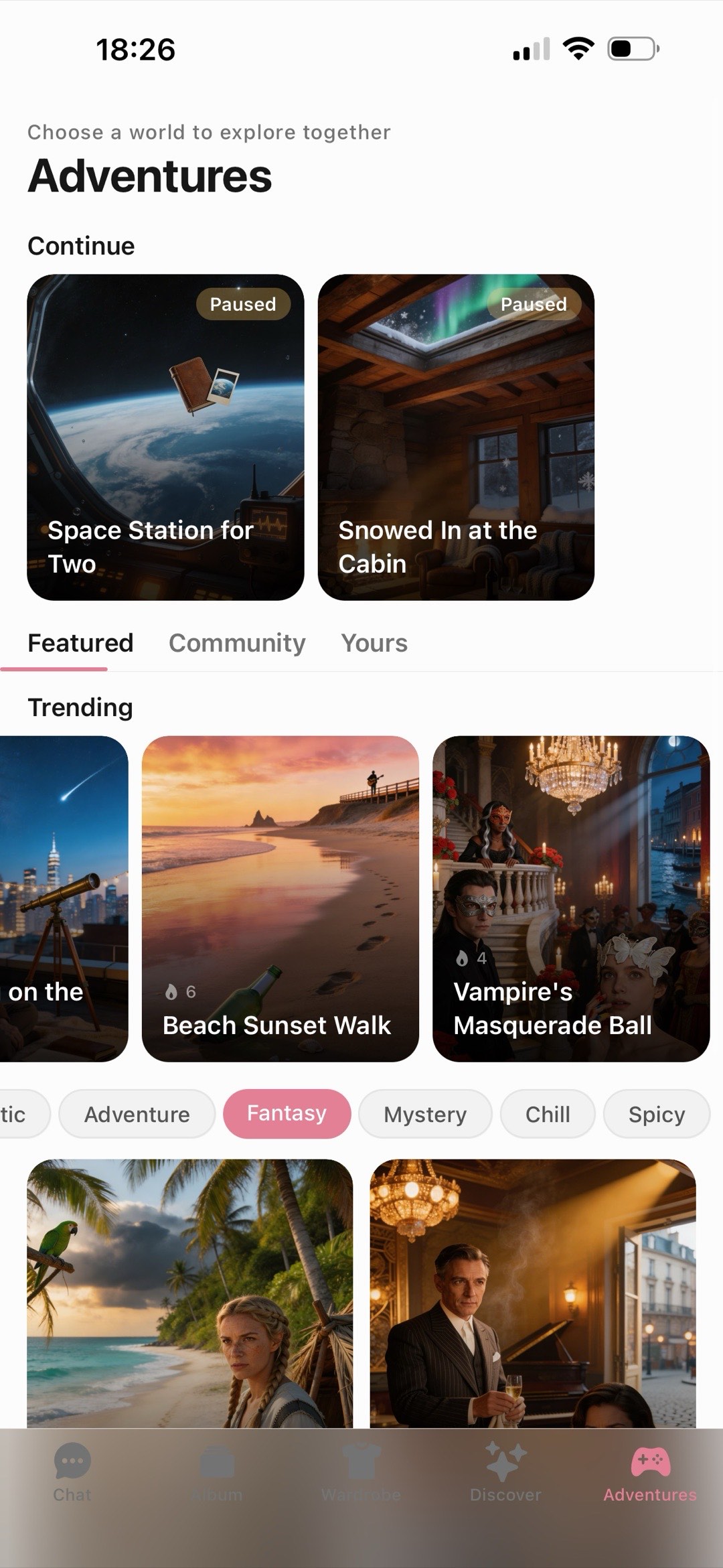
You want to live a story that knows you: pick Kissable. This is our app, so weigh the recommendation accordingly, but the fit is architectural: it is built as one mind end to end. The companion who writes to you is the same system that photographs the scene, voices the line, and remembers that you hate cilantro from a conversation in March. Photos land inside the story as it happens, in realistic or anime style, and Together Photos put you in the frame, which no other tool on this page attempts. The honest cons: it is one continuing story with one companion at the center, not an anthology machine, so writers producing many casts will feel confined; media beyond the included allowance costs Kisses, the in-app currency; and video means 8-second generated messages, not live calls or film-length scenes. Premium is $14.99 a month or $99.99 a year, about $8.39 a month, and it is free to start, no credit card. For the fuller experience of the format, our walkthrough of turning chat into a visual novel shows an evening of it, and the ranked tour of AI visual novel apps compares the whole field.
You are here for interactive roleplay with scenes you can see: that is its own craft, with its own techniques, covered in our guide to AI roleplay with images.
FAQ
Can AI generate a story with matching pictures?
Yes, but "matching" is the hard part. Any modern tool can produce a story and some images; only integrated systems, where the writer and illustrator share one story state, keep the same character across scenes and make the images track the plot. Bolt-on tools produce attractive but disconnected art. The quickest test before committing to any tool: generate two scenes an hour apart and compare the lead character's face.
Why does my story's character look different in every image?
Because the image system never read your story. Most generators send the illustrator a one-line prompt, so every detail the prompt omits is randomized on each render, including the face. Tools that maintain a persistent character identity fix this; prompt discipline alone does not.
What is the best AI story generator with pictures?
For writing projects, NovelAI, with AI Dungeon for freeform adventure. For self-contained illustrated anime stories, Ifable. For a continuing story that remembers you, keeps one face across every image, and can include you in the frame, Kissable. There is no single winner; there are three different jobs.
Can the AI put me in the story's pictures?
On most platforms, no. As of mid-2026, Kissable's Together Photos are the exception we can verify: the system composes you and your companion into one image based on the scene you are in. Our guide to AI girlfriends that send pictures covers how in-story photo generation works more broadly.
Are AI story generators with pictures free?
Mostly free to start. AI Dungeon includes free image generation, Ifable and Sekai have free tiers, and Kissable is free to begin. NovelAI offers only a small one-time allotment before requiring a subscription. Heavy image use ends up paid on every platform; generation costs someone something.
Can these tools write adult stories?
Policies differ sharply, so check before committing. As of mid-2026, NovelAI leaves subscriber prose unpoliced and AI Dungeon is permissive in private play. Kissable allows adult-intimacy chat for users who opt in, within its Content Standard, while its generated visuals stay cinematic and suggestive rather than explicit. General-audience platforms like Talkie, Linky, and Ifable moderate content.
Do the pictures arrive as the story happens, or afterward?
This is a surprisingly good sorting question. Most tools render on request, after the writing, as a separate step. In visual-novel-style apps the image is delivered inside the story flow at the moment the scene occurs, which is what makes the result read as an illustrated narrative rather than a text file with attachments.
AI Research Writer
Maya covers AI companion technology, safety, and the psychology behind human-AI relationships. She focuses on what the research actually says, and what it doesn’t.