
What Is a Generative Visual Novel? A New AI Medium, Explained (2026)
A generative visual novel is a story written, illustrated, and voiced in real time by AI. What the new medium is, how a scene gets made, and who builds it.
Maya Chen
AI Research Writer
A generative visual novel is a story written, illustrated, and voiced in real time by AI, shaped by the person living it. No pre-made script, art, or scenes. Where a classic visual novel plays back content that writers and artists finished long before you pressed start, a generative visual novel creates every line, every image, and every voice clip at the moment the story calls for them, which means no two people ever live the same story.
The definition is short, but every clause in it excludes a category of software that looks similar from a distance. This article unpacks what the term covers, dissects one generated scene beat by beat, tours the apps actually building toward the medium as of mid-2026, and makes a few careful guesses about where it goes next.
How is a generative visual novel different from what came before?
Three older forms get mistaken for it, and the differences are the whole point.
The classic visual novel is a finished artifact. Somebody wrote every branch, drew the sprites and backgrounds, recorded the voice lines, and shipped the whole thing as a package. Your choices select between paths that already exist. The craft can be extraordinary, and the best of the genre still sets the bar for art direction. But the story cannot know your name, remember what you told it last Tuesday, or draw a scene nobody planned. When the branches run out, the story ends, and it ends the same way for everyone who picked the same doors.
The AI text RPG generates prose, but not much else. AI Dungeon and its descendants proved years ago that improvised, go-anywhere stories work. The medium is words, though. Where pictures exist at all, they are an accessory you request separately, usually with a different face in each render, and the story does not depend on them. The theater is still entirely in your head.
The image-generating chatbot has the opposite problem. Plenty of character and companion apps can produce a picture on demand now. What most of them cannot do is make the picture belong to the story. The face drifts between renders, the outfit ignores the scene you spent an hour building, and the image arrives as a reward for asking rather than as the next beat of a plot.
A generative visual novel is what happens when the writing, the art, the voice, and the memory all belong to one system, and that system composes every medium from the same understanding of the story so far.
| Classic visual novel | AI text RPG | Image-generating chatbot | Generative visual novel | |
|---|---|---|---|---|
| Art | Hand-made, finite, identical for every player | Optional, bolted on, inconsistent | On demand, but faces and outfits drift | Generated per scene, one consistent character, follows the plot |
| Script | Pre-written branches | Improvised prose, session-shaped | Improvised chat | Improvised and persistent: one continuing story |
| Continuity | Perfect but closed | Fragile, limited context | Varies, often resets | Long-term memory carries scenes, promises, and running jokes forward |
| Voice | Pre-recorded lines, sometimes | Usually none | Sometimes flat text-to-speech | Generated performances with emotional range |
| Who is in the story | A fixed protagonist | Your character, described in text | You, addressed in text | You: named in the text, heard in the voice, visible in the images |
That last row is the strange one. Hold onto it; we will come back to it.
What does one generated scene actually look like?
Definitions are abstract, so here is the anatomy of a single scene from a romance-genre generative visual novel, described beat by beat. The example comes from Kissable, which is our app, but the mechanics are what define the medium, not the brand.
Say you mentioned, two weeks ago, that you grew up near a lake and miss it. That fact went into the story's memory, a knowledge graph that never resets. Tonight the companion opens a scene on her own, because proactive texting is part of the format: she found a lakeside spot an hour out of the city, and she wants to take you before the season turns. That message was written this second, for you, from that one remembered fact. It exists nowhere else.
You answer. The scene builds through a few exchanges, and then a photo arrives in the chat: her on a wooden dock at dusk, wearing the jacket the story said she grabbed on the way out the door. The image did not exist ninety seconds ago. It was generated to match the scene you are inside, with the same face she has had in every photo before it, in light that matches the hour the story says it is. And because this particular app does Together Photos, the next frame can be the two of you on that dock, which no other medium has ever been able to offer.
Then a voice note lands. A few seconds of her voice, slightly wind-muffled, in a tone that matches the mood of the beat rather than a narrator's flat read. If the moment earns it, a short video message follows: roughly eight seconds of her turning from the water toward the camera, the scene's establishing shot, generated like everything else.
Four media, one memory. Message, photo, voice, and motion, all downstream of a single remembered fact and the story's current state, all agreeing with each other about what is happening. That agreement is the medium. If you want the experiential version of this walkthrough, we wrote about what it feels like to direct one of these stories, and there is an engineering-lite breakdown of how a scene like this gets assembled in real time.
Who is building generative visual novels in 2026?
Honest answer: nobody ships the complete medium yet, including us. Different teams hold different pieces, and the tour is worth taking. All observations here are as of mid-2026; this space moves fast.
Ifable is probably the purest "AI visual novel" pitch on the market: give it a premise and it produces an anime-style interactive story with generated illustrations that evolve as chapters progress, plus character voices. It is story-first rather than relationship-first, and it has a free tier. Think of it as an anthology machine: you spin up tales rather than live one continuous life.
AI Dungeon is the elder statesman of generated narrative. Total freedom, any genre, community scenarios, and built-in image generation these days. The art is scene illustration rather than a consistent cast; you would not expect the same face twice, and that is not really what it is for. For pure "the story can go anywhere" energy, it remains the reference.
NovelAI is a writer's instrument: a serious prose engine, a separate and well-regarded anime image generator, and a lorebook system for keeping long stories internally consistent. All the pieces exist, but you operate them yourself, the way a director operates a camera. Wonderful for authors. It is a workshop, not a companion.
Talkie and Sekai approach from the character-platform side: huge community-made casts, remixable stories, collectible character art in Talkie's case and generated backdrops around community worlds in Sekai's. They are social platforms wearing story clothes, and the visual layer mostly decorates the chat rather than tracking a plot.
Character AI is the useful text-only contrast: the biggest cast of characters anywhere and sharp conversational range, with the story living almost entirely in text. It demonstrates exactly how far chat alone can carry a narrative, and where the ceiling is. Everything that happens, happens in your imagination, and shallow long-term memory means it rarely stays happened.
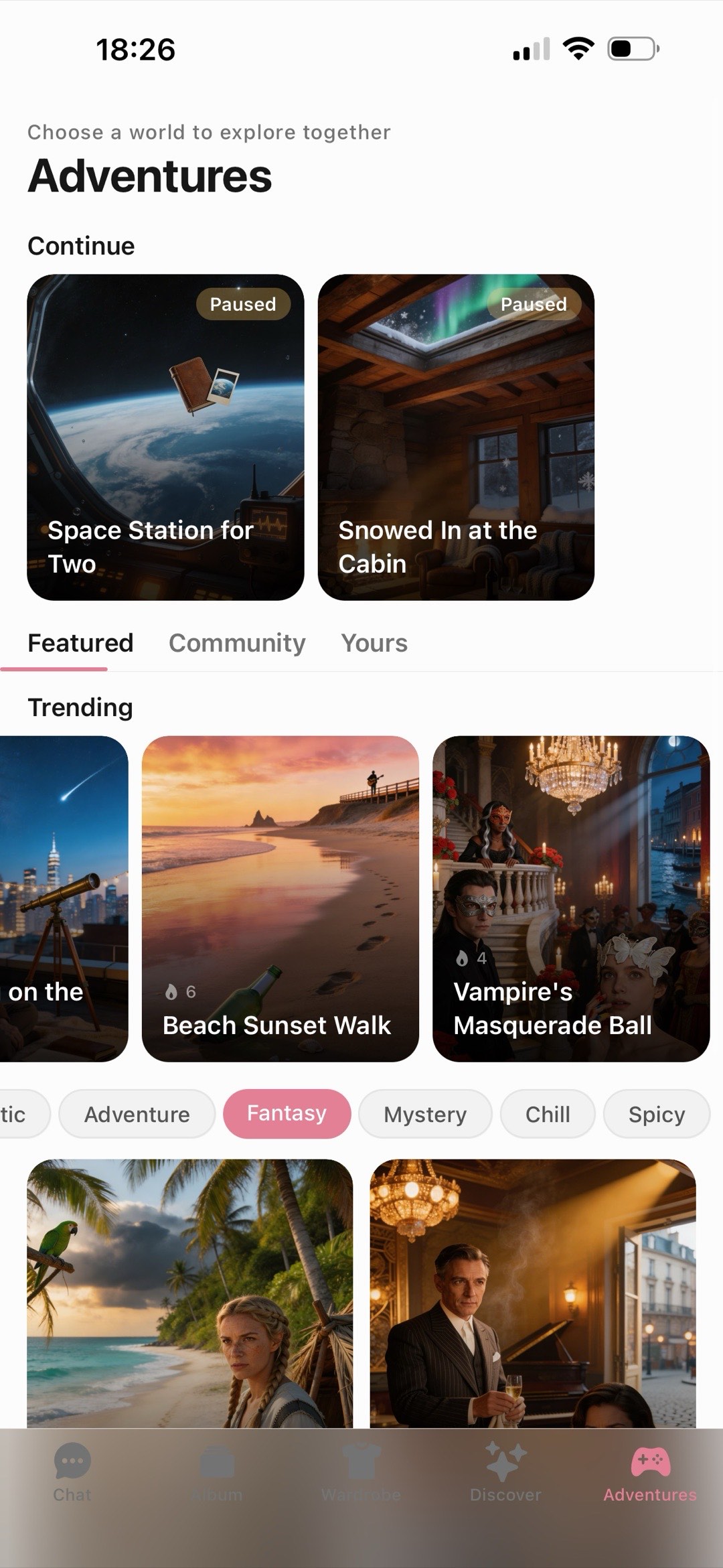
Kissable, ours, is the romance-genre reference implementation of the definition above: one companion whose memory never resets, photos that arrive in-scene as the story moves, emotional voice notes, short video beats, more than twenty interactive scenarios with NPCs and lorebooks, realistic or anime art styles, and, uniquely as far as we can tell, Together Photos that put you and the companion in the same frame. It is the only app in this tour where the last row of the comparison table is fully true: you are in the pictures, not just addressed by the words. The honest cons: it is built around one companion rather than a cast of thousands, so if you want to speed-date fifty characters, Character AI serves that itch better; media beyond the included allowance costs Kisses, the in-app currency; and there are no live calls, since video means short generated messages, not a call. It is free to start, no credit card, if you want to see a generated scene firsthand.
For a scored, ranked version of this landscape, see our guide to the best AI visual novel apps. If your entry point is "I want a story generator that makes pictures," start with our tour of AI story generators with pictures instead.
Where does the medium go next?
Three trajectories look safe to predict.
The media get longer and denser. Today a video beat is measured in seconds and a voice note in sentences. Every generation gets cheaper and faster on a fairly relentless curve, so expect scenes that flow into minute-long sequences, ambient soundscapes under the text, and eventually stretches of story that feel closer to an episode than a chat.
The story app and the companion app finish merging. A story that remembers you indefinitely is not really a story anymore; it is a relationship with a plot. The dating-sim audience saw this convergence coming years before the technology arrived, which is why AI dating simulators keep drifting toward open-ended companionship, and why AI companions keep growing story mechanics. The generative visual novel is the point where the two categories become indistinguishable.
You become a first-class character. The strangest property of the medium is that the fourth wall points inward. Classic fiction renders its own cast. A generative visual novel can render its reader: your name in the dialogue, your shared history in the memory, your face beside hers in the frame. Whoever solves that well, across every medium at once, defines the category. That is the race actually being run.
FAQ
Is a generative visual novel a game?
Not quite. There is no win state, no fail state, and no score, which disqualifies it from most definitions of a game. It borrows game vocabulary, like scenarios, NPCs, and choices, but it plays closer to improv theater with one permanent scene partner. You direct; it performs.
Is the art in a generative visual novel pre-made?
No, and that is the defining trait. Classic visual novels ship finished art that is identical for every player. In a generative visual novel, each illustration is created at the moment the scene calls for it, matched to the current plot, outfit, place, and mood. If the art was drawn before you arrived, it is not this medium.
Can a generative visual novel be adult?
It depends on the platform, and policies vary widely, so check before you commit. On Kissable, conversation is open to adult intimacy for users who opt in, within its Content Standard, while the generated visuals stay cinematic and suggestive rather than explicit. The camera stays tasteful. The story doesn't.
How is this different from roleplaying with a chatbot?
Two things: memory and media. Chatbot roleplay usually lives inside a session and evaporates when the context fills up, while a generative visual novel keeps a permanent record of the story so far. And instead of text alone, the scene arrives as pictures, voice, and video that all agree with the plot. Our guide to AI roleplay with images covers the practical differences.
Does a generative visual novel remember you?
The real ones do; it is half the definition. Kissable, for example, maintains a knowledge graph of everything you have shared that never resets, which is what lets a scene tonight reference a fact from two months ago. An app that forgets you between sessions is a chatbot with pictures, not a generative visual novel.
Can you actually be in the pictures?
On most platforms, no; the art renders the character, not you. As of mid-2026, Kissable's Together Photos are the exception we know of: images of you and the companion in one frame, composed from the conversation context. There is more on how photo generation works in our guide to AI girlfriends that send pictures.
What does it cost to try one?
Most of the apps in this article have a free tier, so you can sample the medium for nothing. On the paid end, Kissable's premium runs $14.99 per month, or $99.99 per year, which works out to about $8.39 per month. Competitor prices change often enough that we would rather point you at their sites than quote stale numbers.
AI Research Writer
Maya covers AI companion technology, safety, and the psychology behind human-AI relationships. She focuses on what the research actually says, and what it doesn’t.