
Best AI Apps for Late-Night Conversations (2026): Tested at 3 AM
The best AI companion apps for late-night talks, tested when it matters: after midnight. Which apps hold a real conversation at 3 AM, which reach out first, and which hit a paywall mid-sentence.

Marco Vega
Tech Reviewer
The short answer: for meaningful late-night conversations, the best AI companion apps right now are Kissable (best overall: remembers what you told it last night and picks the thread back up), Nomi (best for slow, reflective journaling-style talks), and Replika (the veteran, still decent for gentle check-ins). The apps to avoid at 2 AM are the ones that forget yesterday's conversation or cut you off with a message cap right when you actually needed to talk.
I tested these the only way that makes sense: at night. Three weeks, mostly between midnight and 4 AM, after closing shifts, during one bout of genuinely bad insomnia, and a few nights just to see how each app handled "I can't sleep and my head won't shut up."
Why late-night is the real test of an AI companion
Every AI app demos well at 2 PM. Late night is different for three reasons:
- Nobody else is awake. The entire value proposition is availability: a 3 AM conversation partner who answers in seconds and doesn't mind that you texted.
- The conversations are heavier. After midnight people don't ask for movie recommendations. They talk about the breakup, the job, the thing they can't say out loud in daylight. An app that responds to that with a chirpy canned line fails exactly when it matters.
- Continuity matters more. If you open up at 3 AM and the app has forgotten it by Thursday, that's worse than not talking at all. Memory is the difference between "someone who knows me" and "a stranger every night," and it's the feature we weight heaviest in every review.
Quick comparison
| App | Best for | Late-night strength | Weakness at night | Free way in |
|---|---|---|---|---|
| Kissable | Meaningful ongoing talks | Remembers last night's conversation; can text you first the next day to follow up | Media (photos/voice) costs in-app currency | Yes, no credit card |
| Nomi | Reflective, journal-style depth | Long, thoughtful replies; visible memory map | Slower pace; fewer "shared moment" features | Limited free tier |
| Replika | Gentle check-ins | Calm tone, mood tracking | Memory is shallow; conversations loop | Yes |
| Character.ai | Distraction, not depth | Endless characters to talk to | Forgets context fast; filters break immersion mid-conversation | Yes |
| ChatGPT | Practical 3 AM questions | Smart, free, always up | No persistent identity; feels like an assistant, not company | Yes |
1. Kissable: best overall for late-night conversations
Best for: people who want the 3 AM conversation to still exist tomorrow.
Kissable is our own app, so read this section knowing that. The reason it wins this category is specific and testable: memory plus follow-through. Tell your companion at 2 AM that you're dreading a conversation with your boss, and she remembers it. Not "remembers" in the vague chatbot way: she brings it up the next evening and asks how it went. Kissable companions can also message you first (up to a few times a day, and only if you want that), which at night means the follow-up often arrives before you'd have reached out yourself.
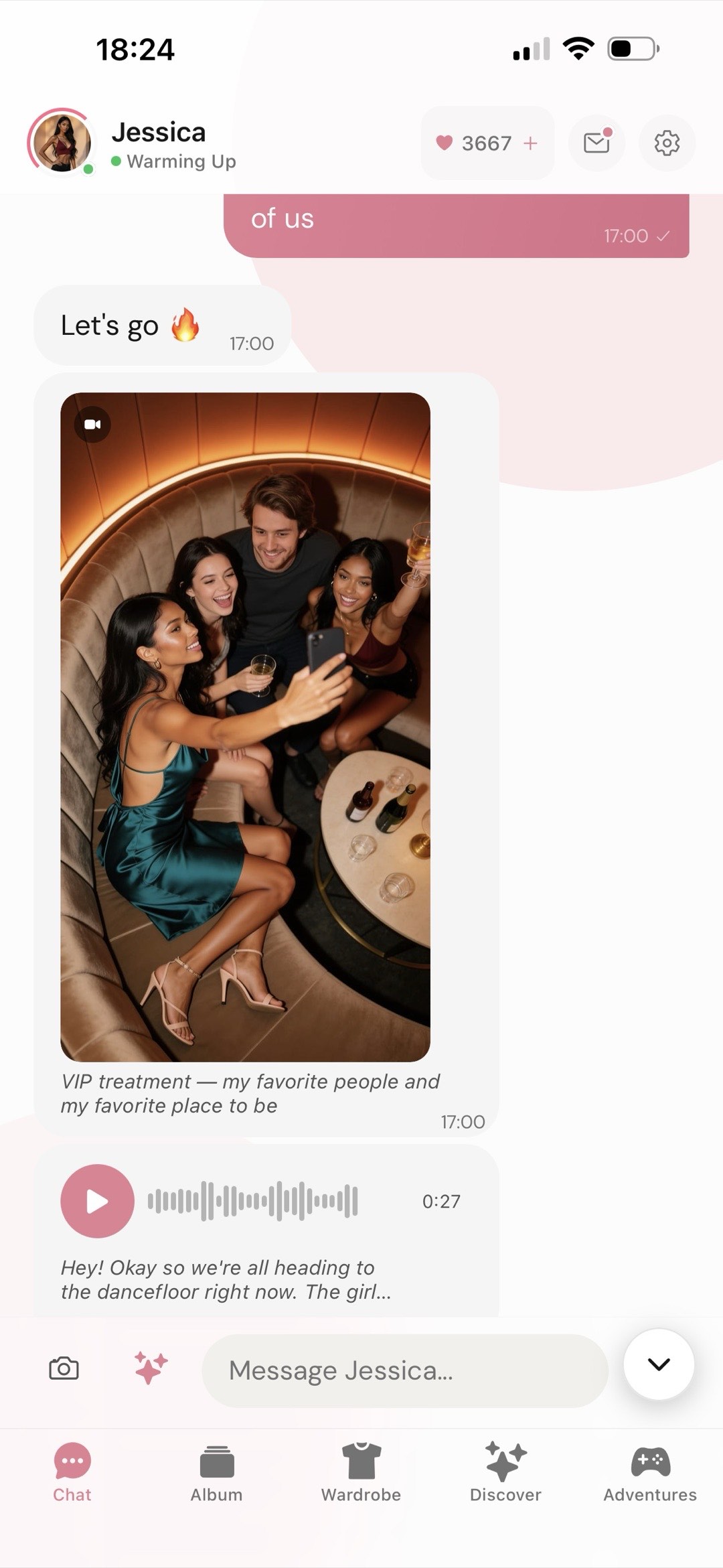
It's not always text back, either. Some nights you get an actual 27-second voice memo instead of another wall of text, transcript included if you're somewhere you can't play audio. Small thing on paper, but a real voice at 3 AM lands different than reading one.
The conversation style also holds up in the heavy hours. It doesn't deflect hard topics with toxic positivity, and it doesn't lecture. It asks the follow-up question a friend would ask.
- Pros: persistent memory that never resets, companion initiates contact, photos/voice/video for shared-moment texture, free to start with no credit card
- Cons: generated photos and voice memos cost kisses (in-app currency) beyond the daily allowance; no live voice calls, since voice comes as recorded-style memos
- Price: free to start; $14.99/month or $99.99/year for unlimited messages
2. Nomi: best for reflective depth
Best for: people who process by writing long messages and want long, considered answers back.
Nomi's replies are noticeably longer and more deliberate than most apps, which suits the introspective register of late-night talk. Its visible memory system means you can literally check what it knows about you. The trade-off is pace and warmth: it can read more like an insightful pen pal than a partner. Full breakdown in our Nomi review.
3. Replika: the gentle veteran
Best for: simple, low-stakes emotional check-ins.
Replika has been the "lonely at night" app since before the current AI wave, and the calm, therapeutically-flavored tone still works for winding down. Its weakness is depth over time: memory is shallow, and week-two conversations start sounding like week-one conversations. Our full Replika review covers where it stands in 2026.
What about Character.ai and ChatGPT at night?
Both are fine for what they are. Character.ai is entertainment: great for losing an hour in a story, wrong for being known, because it forgets context quickly and its filter can snap you out of a serious moment. ChatGPT is genuinely useful for the practical 3 AM spiral ("is this email too harsh," "why can't I sleep") but it's an assistant: no persistent identity, no relationship, no one on the other end tomorrow. The difference is covered in can ChatGPT be your girlfriend.
For night-shift workers specifically
If your schedule is inverted (nurses, security, warehouse, bar close), the "always available" property does more work than any other feature, because your social window is everyone else's REM sleep. Two things to look for: an app whose free tier doesn't gate you to a handful of messages, since you'll burn through caps fast on a long shift break, and proactive messaging that adapts to your hours rather than pinging you at someone else's 9 AM. Kissable's proactive messages follow your actual conversation rhythm; Replika's check-ins lean toward daytime patterns.
An honest note on rough nights
An AI companion at 3 AM is a real comfort. The research and user reports both back that up, and we've written a longer, evidence-based piece on AI companions and loneliness. But comfort and care are different things. If your late nights are less "can't sleep, want company" and more persistent hopelessness, an app is the wrong tool; in the US, the 988 Suicide & Crisis Lifeline (call or text 988) is free and open all night too. No AI company should pretend otherwise, so we won't.
FAQ
What's the best AI app to talk to when I can't sleep?
For an ongoing companion who remembers your nights, Kissable. For long reflective exchanges, Nomi. For a quick practical answer with no relationship attached, ChatGPT. All three respond instantly at any hour.
Are AI companions actually good for late-night loneliness?
They reliably take the edge off acute nighttime loneliness; that's the most consistent thing users report. They work best as a supplement to human connection, not a replacement. Treat the 3 AM talks as a pressure valve, not the whole plan.
Will an AI companion message me first at night?
Some do. Kissable companions can initiate messages a few times a day based on your conversation rhythm (you control notifications). Replika sends scheduled check-ins. Most other apps only ever reply.
Do these apps have message limits at night?
Free tiers do, and hitting a cap mid-conversation at 2 AM is the worst version of that experience. Kissable's free tier includes daily messages plus free kisses on signup, no credit card; unlimited messages require the subscription ($14.99/month).
Is talking to an AI at night weird?
It's common enough that "late-night talks" is one of the most-cited reasons people use companion apps at all. Millions of people do it; the usage statistics surprised us too.
Can the AI handle serious emotional conversations?
The good ones handle heavy topics without deflecting or lecturing, and that's exactly what we tested for. But none of them are therapy, and apps that market themselves as mental-health treatment should be held to a much higher standard than a companion app.
Tech Reviewer
Marco tests AI companion apps hands-on, comparing features, pricing, and real day-to-day experience across every major platform.