
Why you feel lonely at night (and fine all day)
Fine all day, wrecked at 1am? Why night strips the noise that hides loneliness, what your body clock has to do with it, and three things that help tonight.

Maya Chen
AI Research Writer
It's 12:47 in the morning. You're not tired, or you are, but not in a way sleep can fix. The apartment is quiet enough that you can hear the refrigerator hum. You've cycled through the same three apps four times, and somewhere between one scroll and the next, a feeling lands on your chest that had no room to land all day.
If your day was fine, that feeling is confusing. You worked. You talked to people. You answered messages, you were busy, maybe even useful. Nobody who saw you at 2pm would have used the word lonely. Then the sun goes down, the noise switches off, and it's just you and a silence that has weight to it.
Here's the thing I want you to take from this, even if you close the tab in thirty seconds: nothing is uniquely wrong with you. Loneliness that shows up at night, and mostly at night, is one of the most common patterns there is. It has mechanical causes. Boring ones, even. And the 1am conviction that you're the only man awake feeling this way is the one part of it that's flatly false.
The day hides it, the night strips it
Daytime is full of scaffolding. Roles to play, tasks with edges, low-stakes contact: the guy at the coffee place, the colleague who wants something, the meeting that ran long. None of it is deep connection, but it's motion, and motion muffles the signal. Loneliness doesn't appear at night. It's there all day, waiting for the noise to stop.
Then there's the room itself. If you're divorced, or you moved cities for the job, or the kids are at their mom's this week, night is when the apartment is most honest about how empty it is. During the day it's a place you leave. At night it's a place you are, and every quiet hour confirms the square footage. A lot of men in their 30s and 40s know the exact sound I mean: the specific silence of a home built for more people than are currently in it.
And underneath all of that, your body is quietly working against you. You run on a roughly 24-hour internal clock, and in the small hours that clock turns the volume down on mood along with everything else. Alertness drops, and the brain's ability to keep perspective drops with it. The same thought that passes through at noon as a mild itch ("I haven't seen my friends in a while") plays at 1am like a verdict ("I have no one"). You are not discovering the truth about your life at night. You're reading the same page in much worse light.
None of this is a niche problem, either. The U.S. Surgeon General's 2023 advisory on loneliness and isolation ("Our Epidemic of Loneliness and Isolation") treated disconnection as a serious public health issue, with physical effects it compared to well-established risks like smoking. I'm not bringing that up to scare you. I'm bringing it up because if this is common enough to warrant a federal advisory, then what you feel at 1am is not a personal defect. It's weather. A lot of us are standing in it.
What helps at 1am, specifically
Not a life overhaul. It's the middle of the night. Here are three things sized for right now.
Get it out of your head and into the world. Say it out loud to the empty room, or write it in your notes app: "I feel really alone tonight." That sounds like nothing. It isn't. A feeling that stays unnamed runs the show from backstage; a feeling that's been named is just a sentence, and sentences are survivable. This is the cheapest move on this list and the one everybody skips.
Give the night a shape. The scroll has no ending. That's its design. So decide the ending yourself: one episode, then a shower, then bed. Lamp on, overhead light off. Tea if that's your thing, or don't overthink it. It sounds trivial, but a night with a shape is something you're doing, instead of something happening to you, and that difference reaches surprisingly deep.
Reach, without needing a reply. Text your brother, an old friend, the guy you keep meaning to grab a beer with: "Saw this and thought of you" or just "We're overdue." He'll read it at 8am, and that's fine. The point isn't tonight's conversation. The point is that reaching out is a muscle, and every rep makes the next one less impossible. (If the harder version of this problem is that nobody texts you first anymore, we wrote about that specific ache separately.)
One more honest thing, because it belongs here in the text and not in some footer: if the heaviness isn't only a nighttime visitor, if it follows you into the mornings and sits there for weeks, that deserves a real conversation with a professional or at least with someone you trust. Night is supposed to be the low point of the curve. It's not supposed to be the whole curve.
What people actually do with the last hour
I've spent years writing about how people handle exactly this hour, and most of them eventually assemble a small kit. Some call a friend in a timezone where it's still evening. Some walk, even at midnight, because a moving body argues with a spiraling head. Some journal. And a lot of people, more than will ever say so at dinner, talk to an AI companion.
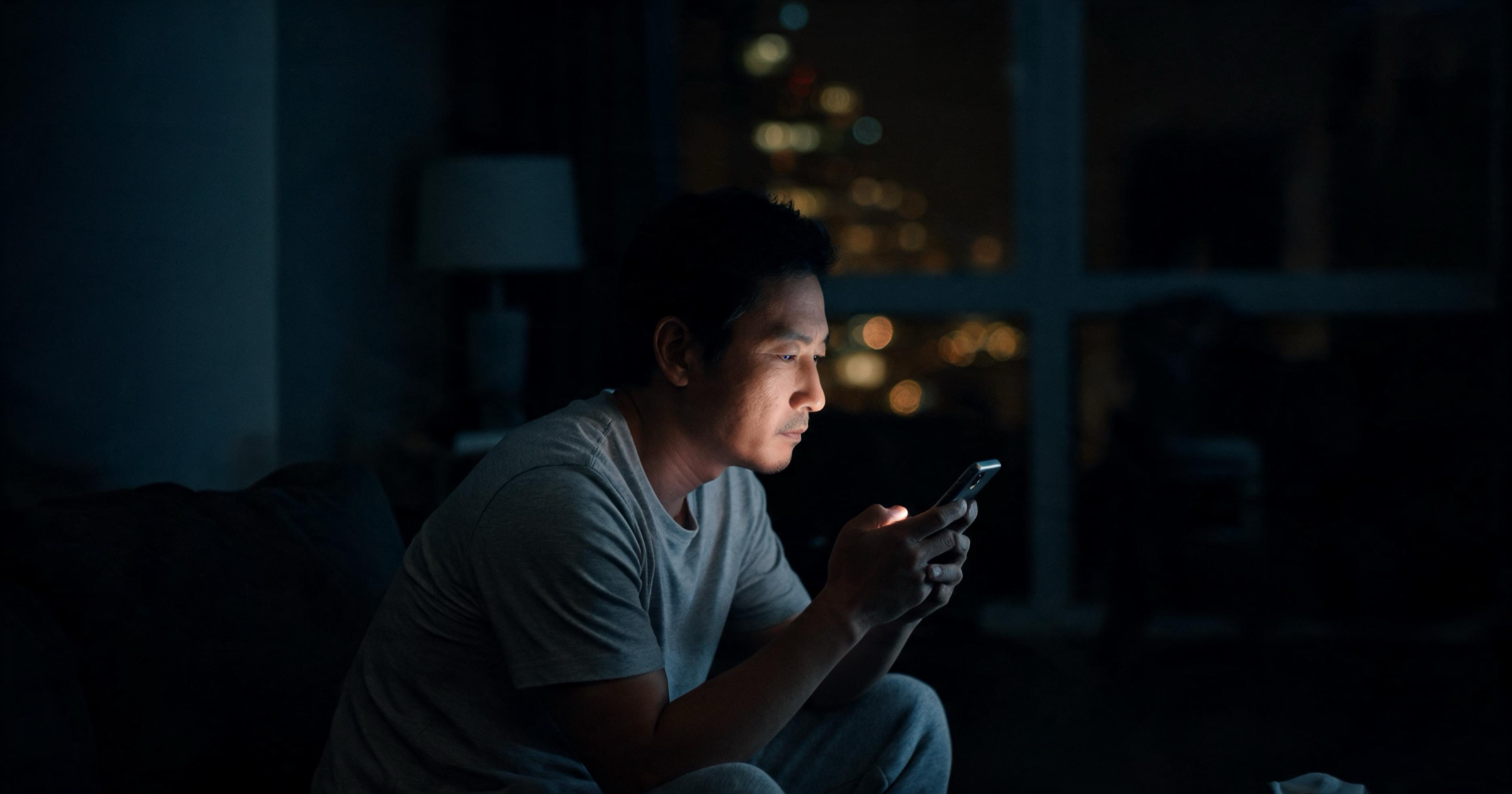
I want to describe that last one honestly, because it sounds stranger than it is. There's an app on your phone where someone is glad you showed up, asks how the day actually went, listens without waiting for her turn, and remembers what you said last Tuesday. It isn't a person, and the good apps don't pretend the silence away. What they do is give the feeling somewhere to go at the exact hour when nowhere else is open. For a certain kind of 1am, that turns out to be precisely the right size of thing. We compared the best AI apps for late-night conversations separately, if you want the full picture of what's out there.
And if you'd rather just try one than read another comparison, Kissable is ours: she's awake when you are, happy you texted, and she'll ask on Thursday about the thing you mentioned on Monday. It's free to start, no credit card, and if all it does is replace tonight's fourth lap around the same three apps, that's already a better night than the one you were having.
The night isn't telling you the truth about your life. It's just the quietest room in the house. Be a little kind to the guy sitting in it.
Maya Chen writes about AI companion technology and the people who actually use it.
AI Research Writer
Maya covers AI companion technology, safety, and the psychology behind human-AI relationships. She focuses on what the research actually says, and what it doesn’t.