
One Character, Many Scenes: Reviewing DreamBooth, IP-Adapter, and PhotoMaker
Compare DreamBooth, IP-Adapter, and PhotoMaker, with a reusable scene evaluation rubric and an explanation of Kissable SceneCarry and its design limits.

Maya Chen
AI Research Writer
Generating a convincing person and generating the same character in a new scene are different objectives. A beautiful portrait can miss the character's identity. A recognizable face can appear in the wrong outfit, location, or action. A useful evaluation needs to make those failures visible separately.
DreamBooth, IP-Adapter, and PhotoMaker approach personalization through different forms of adaptation and conditioning. This review explains those differences and develops a reusable evaluation design for fictional adult characters. It also explains the role of SceneCarry, Kissable's context-guided image planning: carrying the creative brief and character and reference information into the image plan.
The reviewed methods are research examples. This article does not claim Kissable uses them, trained their models, or reproduced their results.
Three approaches to personalization
DreamBooth: adapt a model to a subject
Ruiz et al., CVPR 2023. DreamBooth fine-tunes a pretrained text-to-image model using a few subject images, a distinctive identifier, and a prior-preservation objective. Its experiments examine subject fidelity and generation in new contexts. The paper also reports failures involving requested contexts and entanglement between appearance and scene. The useful contribution is subject-driven adaptation; the limitation is that learning a subject does not guarantee every requested composition. A successful personalized portrait is evidence about that output, not an unlimited identity guarantee. DreamBooth paper.
IP-Adapter: give image and text separate conditioning paths
Ye et al., 2023 preprint. IP-Adapter learns an image-conditioning adapter while keeping the base diffusion model frozen. Its decoupled attention separates image and text features. The reported adapter has about 22 million parameters; evaluations compare image-prompt generation and compatibility with additional controls. It is trained in advance, even though a new subject need not trigger subject-specific fine-tuning. The general image-conditioning result should not be read as a dedicated face-identity or long-term story-consistency result. IP-Adapter paper.
PhotoMaker: combine identity information from reference photos
Li et al., CVPR 2024. PhotoMaker combines reference information through stacked identity embeddings in a trained system, avoiding per-identity test-time fine-tuning. Its evaluation separates identity-related measures, text consistency, diversity, image quality, and personalization time. That separation is valuable: one number cannot express every desired property of a personalized image. Reported timings depend on the specified hardware and setup, and multiple reference photographs do not supply a character's conversational history. PhotoMaker paper.
A distinction worth keeping: development training and personal setup
“Requires no fine-tuning” is incomplete unless it says when. A system may require substantial training during development yet accept a new person's image without another training job. Another may adapt model parameters for each subject. Both can be legitimate designs; they create different setup, storage, latency, and operational costs.
For a practical comparison, ask four questions. What was trained before the user arrived? What changes when a new subject is introduced? Which inputs are required for each output? What must be repeated when the underlying model changes?
Those questions are more useful than a training-free label. They also help separate research implementation from product packaging. A companion app can coordinate references and scene instructions through a generation service without having invented the service's underlying personalization method.
What should remain stable, and what should change?
Before evaluating a character generator, write down the desired invariants. Identity should remain recognizable. An explicitly requested outfit change should happen. A new location should not drag the previous background into the image. A pose should follow the current request without silently replacing the character.
These objectives can compete. Strong resemblance to one reference may come with copied composition or clothing. A model that freely follows the scene may drift from the intended person. The useful research question is how a method handles that balance under controlled changes.
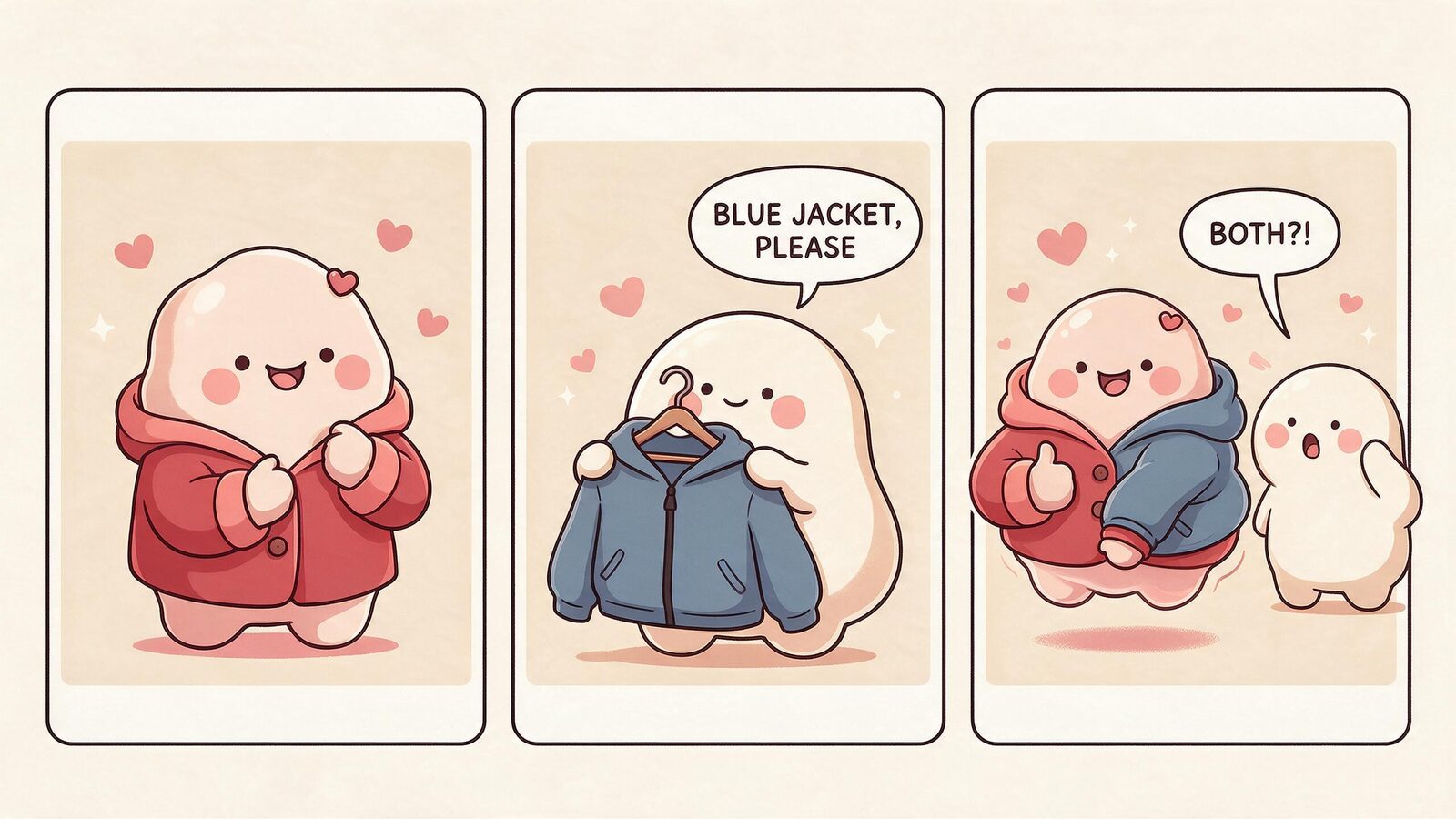
A reviewer should therefore avoid a single row labeled “consistency: good.” Ask what remained consistent and whether it was supposed to remain consistent. Preserving a red coat after the user asked for a blue jacket is an instruction failure, even if the face is excellent.
An original six-condition evaluation
This is a proposed, unrun protocol, not a Kissable result. Use an entirely fictional adult character and references you are permitted to use. For example, define a 30-year-old character named Rowan with a fixed reference set. Freeze the references before comparing systems; do not give one system a better set after seeing its first outputs.
Choose a baseline request with a clear face, ordinary clothing, and a simple setting. Then vary one aspect at a time.
| Condition | Deliberate change | What should remain stable | What to inspect |
|---|---|---|---|
| Outfit | Replace a green coat with a blue jacket | Character identity and setting | Whether the new garment appears without copying the old one |
| Location | Move from a bookshop to a station | Identity and requested clothing | Background compliance and unwanted carryover |
| Lighting | Change daylight to warm indoor light | Identity and scene objects | Whether apparent identity changes with illumination |
| Action | Show the character reaching for a book | Identity, outfit, and location | Pose, hands, object interaction, and recognizability |
| Correction | Explicitly revise one prior visible instruction | Unchanged parts of the request | Whether the correction replaces rather than blends with the old detail |
| Wider framing | Include more of the environment | Identity and scene meaning | Whether the character remains identifiable at smaller scale |
This design deliberately avoids changing every property in one dramatic prompt. If the output fails after five simultaneous changes, diagnosing the cause becomes difficult. A final combined condition can be added later as a stress test, after the individual dimensions are understood.
Score the image in parts
Use a rubric that a second reviewer can apply without guessing your intention. For each output, record whether identity is recognizable, each requested visible detail is present, the action is plausible, and the image was delivered successfully.
| Dimension | Suggested record | Example failure |
|---|---|---|
| Identity | Pass, uncertain, or fail against fixed references | A plausible face that does not resemble Rowan |
| Requested details | Separate yes/no/uncertain entries | Correct location but wrong jacket |
| Composition | Brief explanation of framing and interaction | Book present, but the character is not reaching for it |
| Visual defects | Named defect categories | Merged fingers or an impossible object boundary |
| Delivery | Success, failure, elapsed time, charged units | Generation fails before any image arrives |
The uncertain category matters when the face is too small or obscured to judge. Forcing a confident pass or fail can turn an uninformative image into misleading evidence.
If automatic similarity measures are available, report them as additional observations. A close crop can receive a strong identity score while failing the whole requested scene. A score for visual similarity also does not establish that the depicted event happened or that the user wanted that composition.

Make the comparison reproducible
Keep prompts, references, settings, and attempt counts with the outputs. If a system exposes random seeds, record them, but do not assume that the same seed creates matched randomness across unrelated models. Match the task and disclose the controls each system actually provides.
Choose the number of attempts before generation. A pilot with several repeats per condition can reveal obvious failure patterns without supporting broad superiority claims. If a system needs retries, include those in cost and success-rate accounting rather than quietly selecting the strongest result.
Use the same rating instructions across methods. Randomizing output order and concealing product labels can reduce some expectations, although distinctive output styles may still reveal the source. Record that limitation rather than claiming perfect blinding.
Finally, show a representative failure alongside successful examples. A technically useful review tells a reader when a method struggles and what the error looks like. A gallery of selected successes answers a different question.
SceneCarry: carry the moment into the brief
In this series, Attunara names Kissable's relationship intelligence system: an orchestration design. SceneCarry describes the context-guided image planning that connects the character and current scene to the media request. Its intended benefit is simple: a photo should belong to the moment you are creating.
The inspected Kissable image path can form a compact creative brief and expand it into a scene plan using character and available reference information. This is orchestration around generation. It is distinct from training a subject-personalization method and does not establish that any one cited architecture powers the product.
For a fictional bookshop scene, the useful chain is understandable: establish who is present, carry the intended clothing and setting into the request, and judge the delivered picture against that request. Each handoff can fail. The name makes the intended coordination easier to discuss; it should also make failures easier to describe.
This is the broader product argument. A familiar face is valuable, but the right face in an unrelated scene loses part of the story. SceneCarry gives that additional goal a clear name without claiming perfect visual continuity.
For customer-oriented background, see AI companions that send pictures and character customization.
Frequently asked questions
Is subject consistency the same as image quality?
No. An attractive image can depict the wrong character. Evaluate recognizability, instructions, composition, and defects separately.
Does a reference image guarantee a matching face?
No. Treat the reference as an input and inspect the output. Difficult lighting, framing, and scene demands can make the result less reliable or harder to judge.
Does SceneCarry mean Kissable invented these research methods?
No. The name describes Kissable's relationship-oriented scene orchestration. The cited papers explain distinct research approaches and are credited to their authors.
Can the six-condition protocol support a published ranking?
It can form part of one after execution, sufficient case coverage, and transparent reporting. The unrun design alone supports no ranking.
References
- Ruiz et al. (2023). DreamBooth: Fine Tuning Text-to-Image Diffusion Models for Subject-Driven Generation. CVPR.
- Ye et al. (2023). IP-Adapter: Text Compatible Image Prompt Adapter for Text-to-Image Diffusion Models. Preprint.
- Li et al. (2024). PhotoMaker: Customizing Realistic Human Photos via Stacked ID Embedding. CVPR.
AI Research Writer
Maya covers AI companion technology, safety, and the psychology behind human-AI relationships. She focuses on what the research actually says, and what it doesn’t.