
How to Create NPCs for AI Roleplay (2026 Guide)
Learn how to create NPCs for AI roleplay that feel real: distinct personalities, speaking styles, AI portraits, and memory. Free templates included.

Marco Vega
Tech Reviewer
Quick answer: to create NPCs that feel like real people in AI roleplay, you need four things: a defined personality with flaws, a distinct speaking style with example dialogue, a talkativeness setting that controls how often they speak, and visual identity (an AI-generated portrait). Without all four, your NPCs blend together into a single generic voice. Here's how to build each one, with templates you can copy.
If you've spent any time on Janitor AI or Character.ai, you know the problem. You're trying to run a scene with multiple characters (a detective interrogating a witness, a party where your companion's friends are all present, a heist crew planning the job) and the AI can't keep them straight. Everyone talks the same way. The bartender sounds exactly like the crime boss. The best friend and the rival are indistinguishable after five messages.
That's because these platforms are built for single-character chat. One bot, one personality, one voice. The "Rooms" feature on Character.ai and group chat on Kindroid let you put multiple characters in the same conversation, but they're still separate bots with no shared world knowledge and no way for the AI to differentiate them beyond their individual character cards.
A proper NPC system solves this at the architecture level, which is exactly what the scenario creator in Kissable was designed to do. Here's how it works, and how to build characters that feel like different people.
The Four Pillars of a Good NPC
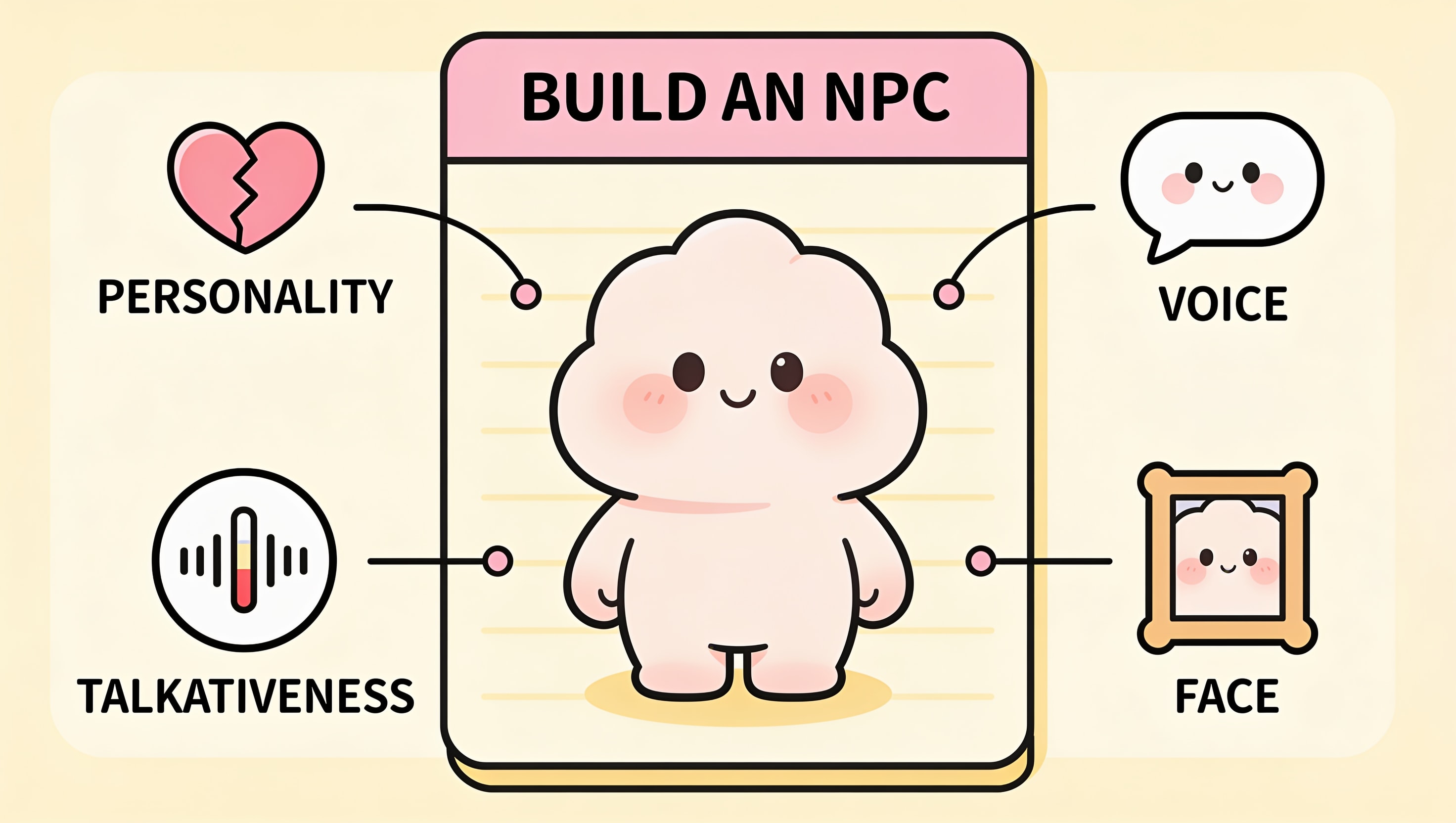
Every NPC you create needs four things to feel real. Skip any one of them and the illusion breaks.
1. Personality (With Flaws)
A personality isn't a list of adjectives. "Smart, kind, brave" produces a character with no edges. The AI needs something to roleplay against: a tension, a contradiction, a flaw that creates friction.
Bad: "Marcus is a detective. He's smart, determined, and good at his job."
Good: "Marcus is a detective who's been on the force for 20 years and has seen too much. He's brilliant at reading people, but he's also drinking too much and his marriage is falling apart. He keeps people at a distance because everyone he's gotten close to has either died or left. He uses dark humor to deflect genuine emotion. When he's close to solving a case, he gets obsessive: sleeps at his desk, ignores phone calls, pushes away anyone trying to help."
The AI now has something to work with. Marcus can be warm one moment and cold the next. He can make a joke that reveals something painful. He can push the player away and then reluctantly let them in. That's a character, not a character sheet.
2. Speaking Style (With Example Dialogue)
This is where most creators stop short. They describe how a character talks but never show it. The AI learns from examples. Give it one line in the character's actual voice and it'll extrapolate.
For every NPC, write at least one line of example dialogue. Make it specific to the character's personality and situation.
Detective Marcus (dark, clipped, world-weary):
"You want my theory? Someone in this room did it. Someone who knew the security codes. Someone who knew the victim well enough to hate them. And someone who's about to get very, very nervous when I ask the next question."
Lena the journalist (warm, curious, asks too many questions):
"Wait, you're telling me you've lived here for three years and you've never been in the basement? How is that possible? I would've been down there on day one. Actually, can we go? Right now? I have a flashlight in my bag."
Viktor the informant (nervous, fast-talking, always checking over his shoulder):
"Look, I told you what I know, okay? Which isn't much. Which is nothing. I don't know anything. Can we please go somewhere with fewer windows?"
The AI will match the sentence length, the vocabulary, the punctuation patterns, and the emotional register of whatever sample you give it. A character who says "I don't know anything" in short, panicked bursts will keep talking that way.
3. Talkativeness
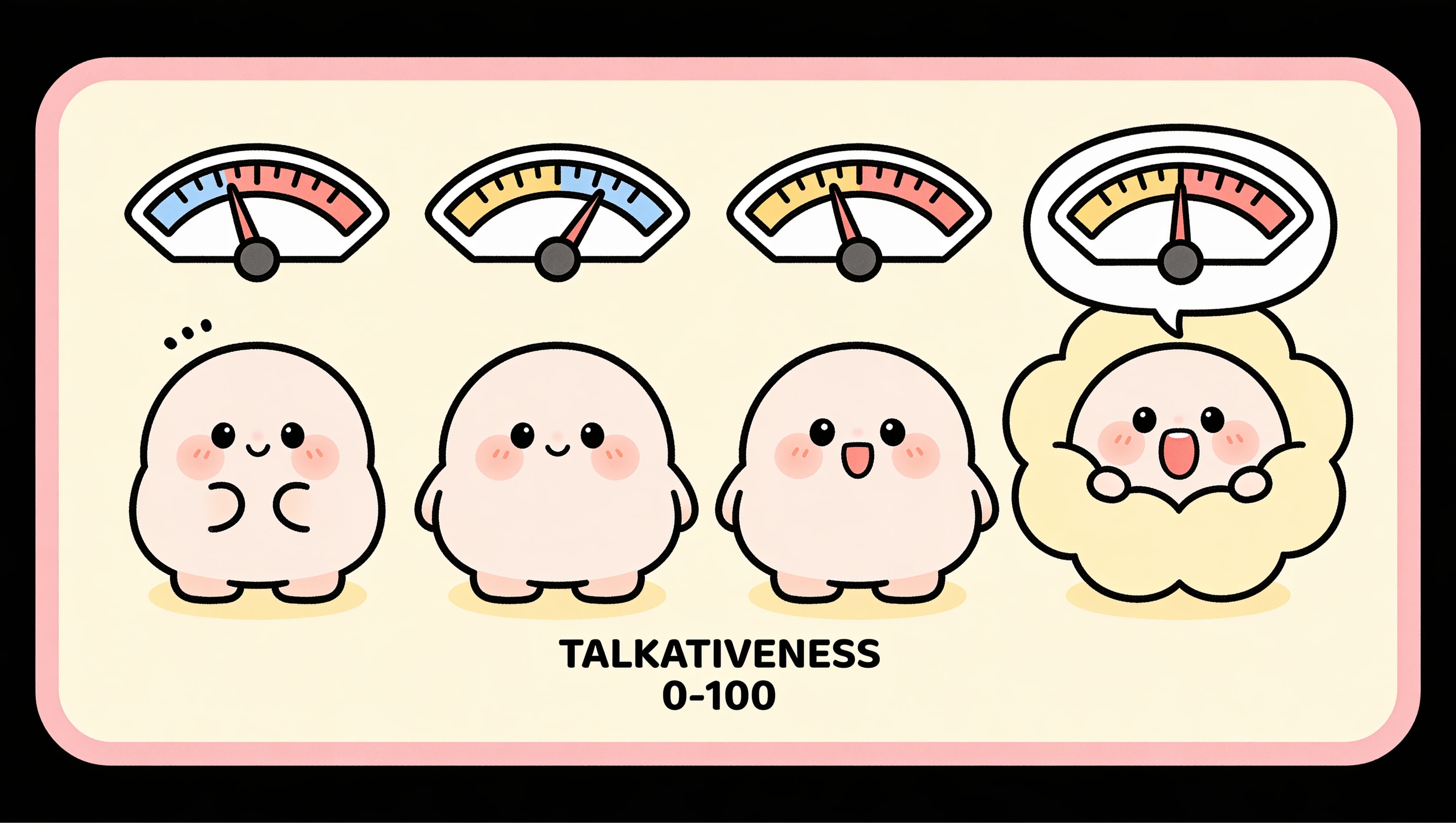
This is the setting most people overlook, and it's the one that prevents every NPC from dominating the conversation equally.
Talkativeness is a 0-100 slider. A bartender who only speaks when directly addressed might be at 20. A chatty best friend who interrupts constantly might be at 85. The AI uses this to control how often an NPC interjects. Without it, every character competes for airtime and the scene becomes noise.
Quick reference:
- 0-20: Speaks only when directly addressed. The silent bodyguard, the mysterious stranger, the traumatized witness.
- 25-50: Contributes when relevant but doesn't dominate. The competent colleague, the supportive friend, the professional contact.
- 55-75: An active participant. The enthusiastic sidekick, the opinionated expert, the rival who's always weighing in.
- 80-100: Can't shut up. The comic relief, the oversharer, the character who thinks every thought needs to be spoken aloud.
For a balanced scene with 3 NPCs, try a mix: one at 30, one at 60, one at 80. The quiet one's rare interjections will carry more weight. The loud one provides energy. The middle one holds the scene together.
4. Visual Identity
The AI generates a portrait for each NPC based on their description, free during creation. This matters more than you'd think. When a character's face appears next to their dialogue in the chat, with a speaker label and their name, your brain assigns them an identity instantly. You stop reading "dialogue attributed to NPC #3" and start reading "Marcus said."
The portrait also feeds back into the AI's behavior. A character who looks tired and weathered will be written differently than one who looks polished and sharp, even if their personality text is similar.
NPC Template (Copy and Fill In)
Here's a template you can use for every NPC you create:
NAME: [Character name]
ROLE: [What they do in the story: detective, rival, informant, best friend]

PERSONALITY:
- Core traits (3-5, include at least one flaw or contradiction)
- What they want (motivation)
- What they're hiding (secret, insecurity, or fear)
- How they handle conflict (fight, flight, deflect, manipulate)

SPEAKING STYLE:
- Sentence length: [short and clipped / medium and natural / long and detailed]
- Vocabulary: [simple / educated / technical / slang-heavy]
- Signature patterns: [catchphrases, verbal tics, favorite words, things they never say]
- Emotional register: [warm / cold / anxious / confident / sarcastic / earnest]

EXAMPLE DIALOGUE:
"[One line in their exact voice, specific to a situation]"

TALKATIVENESS: [0-100]
Example: Building a 3-NPC Scene
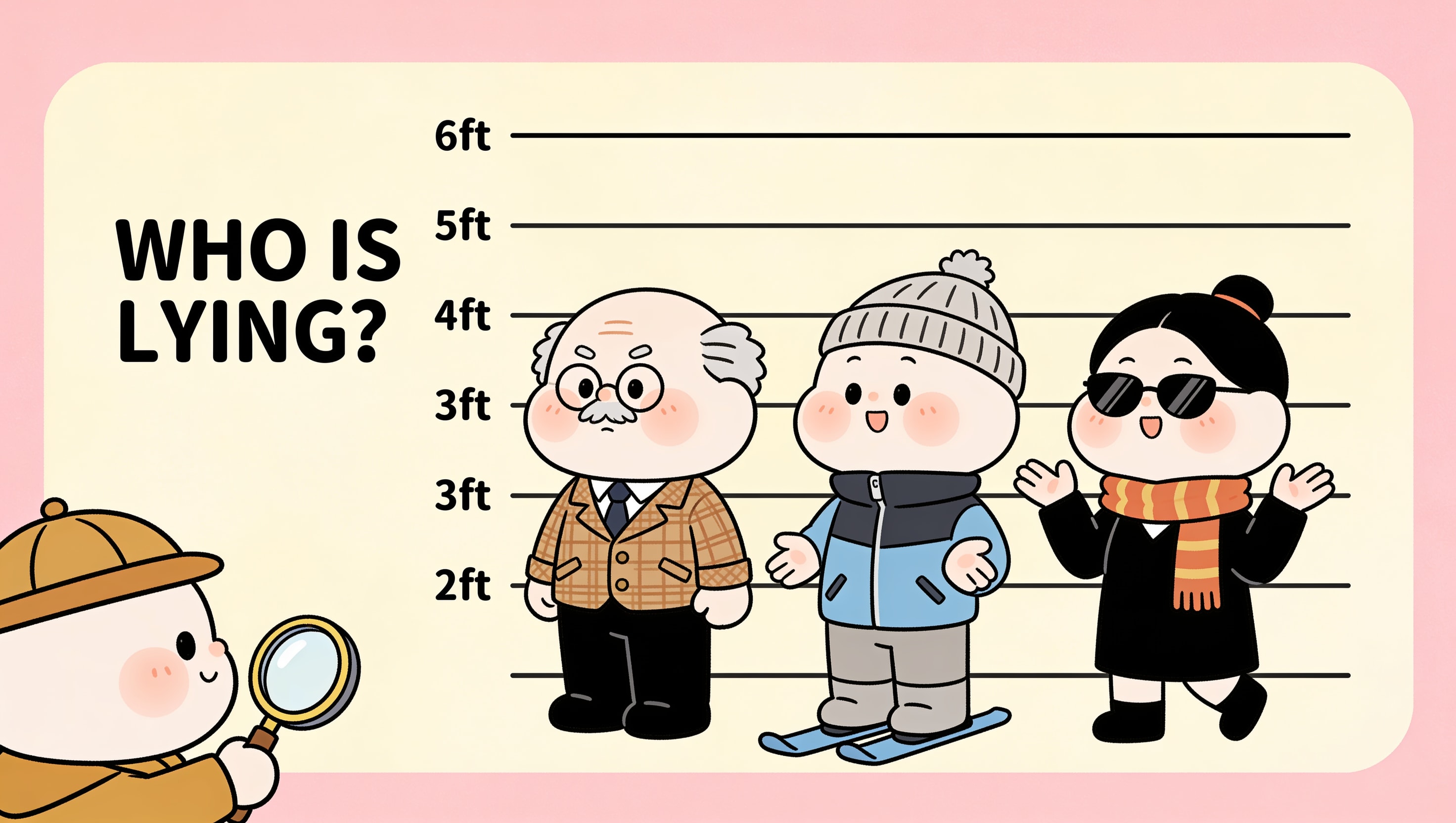
Let's say you're building a murder mystery. The premise: "A body is discovered at a remote ski lodge. The storm has cut off all communication. One of the three other guests is the killer."
NPC 1: Eleanor Vance, retired professor
- Personality: Sharp, observant, intellectually arrogant. She's solved crimes before, in books. She's never encountered a real body and is quietly terrified, which she covers with academic analysis. Flaw: she assumes she's the smartest person in every room, which makes her miss the obvious.
- Speaking style: Formal, precise, uses words like "fascinating" and "empirically." Long sentences. Never uses contractions.
- Example: "The angle of the wound suggests someone considerably shorter than the victim. Or someone kneeling. I'd need to examine the carpet fibers to be certain. Not that anyone will let me."
- Talkativeness: 70
NPC 2: Danny Tran, ski instructor
- Personality: Easygoing, physically confident, emotionally avoidant. He knew the victim (they took a lesson together yesterday) but downplays it. Flaw: he lies by omission, instinctively, even when the truth would help him.
- Speaking style: Short sentences, casual, uses "man" and "like" frequently. Deflects with jokes.
- Example: "Look, I just teach people how to not break their legs on the black diamond, alright? I'm not, like, a detective. You want my opinion? It was probably an accident. People fall. It's a mountain."
- Talkativeness: 40
NPC 3: Celeste Moreau, actress
- Personality: Dramatic, self-centered, secretly broke. She was seen arguing with the victim an hour before the body was found. Flaw: she lies constantly (about her career, her finances, her alibi) because the truth is embarrassing, not because she's guilty. But she looks guilty.
- Speaking style: Expressive, theatrical, uses her hands when she talks (she narrates her own gestures). Overuses adjectives. Punctuates with French phrases.
- Example: "I was in my room! Alone! Doing what? Oh, I don't know, being traumatisée by the fact that there is a DEAD MAN in the lodge? But of course the first thing everyone does is point at the actress. Naturellement."
- Talkativeness: 85
Put these three in a scene together and the AI can differentiate them instantly. Eleanor analyzes. Danny deflects. Celeste performs. The quiet one (Danny at 40) becomes suspicious because he's holding back. The loud one (Celeste at 85) provides energy but also distraction. The middle one (Eleanor at 70) drives the plot forward with her observations.
That's the difference between three character cards and three people.
How NPCs Work in a Scenario
In a proper scenario system (not a single-character chat), NPCs aren't just separate bots thrown into the same room. They share the same world context. The AI tracks who knows what. A character who left in Act 1 won't suddenly comment on something that happened in Act 2.
Here's what happens during gameplay:
- Dialogue segments separate each speaker with a portrait and name label. You can tell instantly who's talking.
- The AI injects NPC context into every message, so all characters are "present" in the scene even when they're not speaking. Eleanor doesn't forget Danny is in the room just because she's the one talking.
- NPCs interact with each other, not just with you. Danny might make a joke, Celeste might react dramatically, Eleanor might correct him, all in sequence, without you prompting each exchange.
- NPCs interact with your companion. Your AI partner has their own relationship to each NPC. They might trust Eleanor, be suspicious of Danny, and find Celeste exhausting. That dynamic plays out alongside your own.
This is fundamentally different from putting three Character.ai bots in a group chat. Those bots don't share context. They don't know what the others just said beyond the most recent messages. They have no visual identity. And they can't reference shared lore without you manually pasting it into each one. A Kissable scenario keeps every NPC inside one shared world, so the context is automatic.
Where Single-Character Platforms Fall Short
| What you need for NPCs | Character.ai Rooms | Janitor AI | Kindroid Group Chat | Kissable Scenarios |
|---|---|---|---|---|
| Multiple characters in one story | Yes (separate bots) | No | Yes (separate bots) | Yes (shared context) |
| Distinct speaking styles per NPC | Manual per bot | N/A | Manual per bot | Built-in style + example dialogue |
| Talkativeness control | No | N/A | No | 0-100 slider per NPC |
| AI-generated NPC portraits | Upload only | Upload only | Upload only | Auto-generated, free |
| Shared world context across NPCs | No (separate bots) | N/A | No (separate bots) | Yes, all NPCs share scenario context |
| NPC-to-NPC interaction | Manual (you prompt each) | N/A | Manual | Automatic: AI choreographs exchanges |
| NPC-to-companion interaction | Manual | N/A | Manual | Automatic: companion has relationships with each NPC |
Common Mistakes When Creating NPCs
Making everyone talk the same way. If all 3 NPCs use the same sentence length and vocabulary, the AI can't differentiate them. Write example dialogue for each one and make them noticeably different: one verbose, one clipped, one casual.
No flaws. Perfect characters are boring. Give every NPC at least one thing they're bad at, scared of, or lying about. The AI needs friction to create drama.
Ignoring talkativeness. If everyone is at 50, everyone competes equally for airtime and scenes become chaotic. Use the slider to create rhythm: quiet moments followed by bursts of dialogue.
Too many NPCs. Above 4 NPCs in a single scene, the AI starts losing track. The sweet spot is 2-3 well-developed characters. Save the 6-NPC limit for stories where characters enter and exit across different acts.
No example dialogue. Describing a speaking style isn't enough. The AI learns from examples. Give it one real line per NPC.
Ready to Build Characters That Feel Real?
If you've been running multi-character scenes on Janitor AI or Character.ai by copy-pasting character descriptions between chats and manually narrating who says what, there's a better way to do this. The NPC system built into the scenario creator handles all of it: distinct voices, AI portraits, automatic dialogue choreography, and shared world context that actually persists.
Start building NPCs for your first adventure: try [Kissable free](/go/app?ref=blog_how-to-create-npcs-for-ai-roleplay), no card needed.
FAQ
How many NPCs can I add to one adventure?
Up to 6. For most scenes, 2-3 well-developed NPCs work better than 6 shallow ones. Use more for stories with characters entering and exiting across different acts.
Do NPCs remember things from earlier in the adventure?
Yes. The scenario's rolling narrative memory tracks character states and key decisions. NPCs won't forget what happened in Act 1 just because you're in Act 3.
Can NPCs interact with my AI companion?
Yes. Your companion has their own relationships with each NPC: they might trust one, be suspicious of another, find a third annoying. That dynamic plays out automatically alongside your own interactions.
Do I need to write dialogue for every NPC interaction?
No. You write the personality, speaking style, and example dialogue. The AI handles the actual conversation dynamically, adapting to what's happening in the story. You don't script lines. You define the character and the AI plays them.
Is there a character limit for NPC descriptions?
Personality and speaking style fields are generous enough for detailed descriptions. Example dialogue is a single line. Keep it tight: the AI performs better with concise, specific character definitions than with essays.
Related Articles
- How to Create AI Adventures: The Complete Guide
- AI Lorebook Guide: How to Build Worlds Your AI Actually Remembers
- How to Share and Publish AI Scenarios: Community Adventures
- Build AI Adventures on Your Phone: Mobile Scenario Creator Guide
- Best AI Girlfriend Prompts and How to Write Them
- How to Make Your AI Girlfriend Remember Things
- Best Character AI Alternatives in 2026
Build NPCs that feel like real people, start free, no credit card.
Tech Reviewer
Marco tests AI companion apps hands-on, comparing features, pricing, and real day-to-day experience across every major platform.