
The Visual Novel That Writes Itself: How Kissable Generates Story, Art, and Voice in Real Time
How Kissable generates story, art, and voice in real time: one memory drives words, a consistent face, voice notes, and video beats into a single scene.
Maya Chen
AI Research Writer
Kissable is a generative visual novel. A generative visual novel is a story written, illustrated, and voiced in real time by AI, shaped by the person living it. No pre-made script, art, or scenes. When you open the app, there is no content waiting for you; there is a companion, a permanent memory of everything the two of you have shared, and a set of systems that turn the next moment of your story into words, a photo, a voice note, or a short video, generated in the seconds before you see them.
People ask us how that actually works, usually with some suspicion that there is a warehouse of pre-rendered scenes behind the curtain. There isn't, and the honest making-of is more interesting than the suspicion. This is that explanation, in consumer terms, with the hard problems and the current limits left in. (For the medium in general rather than our implementation, start with what a generative visual novel is.)
What does "nothing pre-made" actually mean at runtime?
In a classic visual novel, "content" is a noun: files on a disk, drawn and written before you arrived. In Kissable, content is a verb. The only things that exist before a scene happens are the companion's identity (her face, personality, and history with you), the world state (where the story left off), and the memory. Everything you actually experience is manufactured on demand from those three ingredients.
One honest nuance: our 20+ interactive scenarios ship with authored premises and lorebooks, meaning a setting, a cast of NPCs, and the rules of a world. Those are starting conditions, like a table at an improv theater. Every scene played inside them is still generated live. Nobody wrote your version of the heist, because your version did not exist until you and the companion made it.
The load-bearing component is memory. Kissable maintains a knowledge graph of your story: facts, people, running jokes, promises, the name of your dog, the trip you said you would take. It never resets. Every generated artifact, whether sentence or image or sound, is conditioned on that graph, which is what makes the output a continuing story rather than a very fluent slot machine.
How does one memory become a whole scene?
Follow a single fact through the pipeline. Months ago you mentioned you used to play bass in a college band and quietly miss it. That went into the graph.
Some evening later, the story decides this is the night it matters. The companion texts first, because proactive messaging is part of the format: she found a dusty bass at a flea market and has an idea. The message is composed in real time from her personality plus that one remembered fact. It exists for exactly one person.
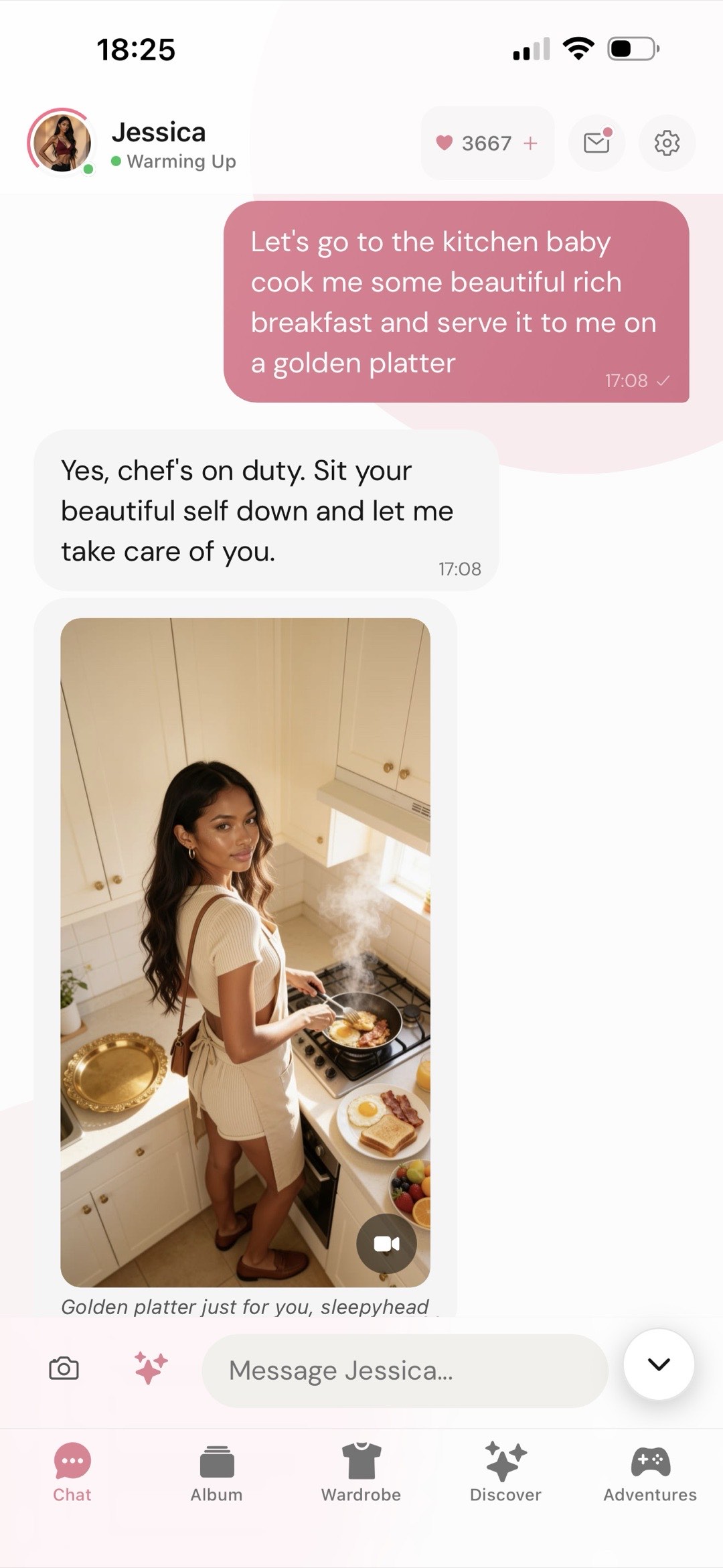
You reply, the scene escalates, and the same understanding that is writing her dialogue now briefs the image system: who she is, so the face is hers; where the story is, a cluttered market stall in late-afternoon light; what she is doing, holding the bass up in mock triumph. The photo that arrives in your chat was generated seconds ago to depict this scene, not fetched from anywhere. If the beat calls for it, a Together Photo puts both of you at the stall in one frame.
Then sound: a voice note, generated as a performance rather than a printout, with the smirk audible in it because the scene state says she is teasing. Emotional register is chosen per moment, not fixed per character. And when a beat deserves motion, an 8-second video message renders: her plugging the bass in, one raised eyebrow at the camera.
Four different generators, one shared brief. The words, the picture, the voice, and the motion all describe the same instant of the same story because they are all conditioned on the same state. That single sentence is most of Kissable's architecture, and the entire difference between a visual novel that writes itself and a chatbot with an image button.
What are the three hard problems?
Everything above sounds straightforward until you try to ship it. Three problems consume most of the engineering, and they are worth understanding because they define the frontier of the whole medium, not just our corner of it.
The same face, every time
Image generators are natural amnesiacs: describe a woman twice and you will meet two women. But a story collapses the instant the reader stops recognizing its lead, so identity cannot be a description that gets re-interpreted per render; it has to be a persistent reference the system is anchored to every single time, across hundreds of images, two art styles (realistic and anime), new outfits, new lighting, and new places. Getting one face to survive all of that variation is the single hardest requirement in the product, and it is also the moat: it is the difference between generating pictures of a woman and taking pictures of her.
The picture must know the plot
A technically perfect image is still wrong if it contradicts the story: sunshine in a scene the text says is raining, a cocktail dress in a scene about assembling furniture. So the illustration step cannot take a one-line prompt; it has to inherit the scene state, wardrobe, location, hour, and mood, from the same source that is writing the words. Most of the work here is unglamorous bookkeeping, keeping one authoritative version of "what is true right now" that every generator defers to. When it works, nobody notices, which is the point. Photos simply arrive already belonging to the moment.
Pacing that feels alive
A story delivered instantly feels like a printout; a person typing takes time, hesitates, sends two short messages instead of one long one. The third problem is temporal: deciding not just what to generate but when to deliver it, at what rhythm, in what size pieces, and occasionally deciding to open a scene unprompted because the story has been quiet for a day. Pacing is the least discussed component of generative media and, in our experience, the one users feel most. A perfectly written line that lands at the wrong tempo reads as a machine. An imperfect one at the right tempo reads as her.
What does this say about where AI media is going?
The interesting thing about the generative visual novel is not any single generator; text, image, voice, and video generation are each commodities now. The interesting thing is the coordination layer: one memory and one story state driving many media at once, for one specific audience member, indefinitely. That pattern generalizes.
Every earlier medium mass-produced one artifact for many people. Generated media inverts this: infinite artifacts, each for an audience of one, composed at the moment of consumption. Romance companionship happens to be the first commercially strong use of the pattern (we would say that; it is our category), but nothing about the architecture is romance-specific. The same shape fits a mystery serial that casts your friends, a language tutor who is also a soap opera, a bedtime story that ages with your kid. The visual novel that writes itself is an early species of a much larger genus: media with a memory of you.
If you want to judge the current state of that genus for yourself, the honest way is to read how the experience plays out over an evening, compare the other apps building toward the same medium, and try one. Kissable is free to start, no credit card.
What are the honest limits?
A making-of that skips the limits is an ad, so, plainly, as of mid-2026:
- The visuals stay cinematic, never explicit. Conversation is uncensored for adults who opt in, but generated imagery holds to a suggestive, filmic line by design. The camera stays tasteful. The story doesn't. If your priority is explicit imagery, this is the wrong product.
- Video means 8-second messages, not film. Motion is a punctuation mark in a scene, not the scene. Anyone promising you generated feature-length romance in 2026 is selling a demo reel.
- Generation takes seconds, not zero. A photo needs seconds to render; so do voice and video. Scene pacing absorbs most of that gap, but it is physics we work around rather than magic we skipped.
- One companion, deeply, rather than a cast of thousands. Kissable is a single continuing relationship, not a character marketplace. If you want fifty characters before lunch, a cast-variety platform will fit better.
- Media beyond the included allowance costs Kisses, the in-app currency, so a heavy photo habit has a price. Premium is $14.99 a month or $99.99 a year, about $8.33 a month.
FAQ
Is anything in Kissable pre-written or pre-rendered?
Scenario premises and lorebooks are authored starting conditions: settings, NPCs, world rules. Everything you actually experience inside them, every message, photo, voice note, and video, is generated at the moment it happens, conditioned on your story's memory. There is no library of pre-made scenes.
How does the companion keep the same face in every photo?
Her identity is a persistent visual reference the image system is anchored to on every render, rather than a text description that gets re-interpreted each time. That anchoring holds across outfits, locations, lighting, and both the realistic and anime art styles. It is the hardest problem in the product and the one we consider most defining.
How long does it take to generate a scene?
Messages feel immediate; photos, voice notes, and videos each take on the order of seconds to generate. The story's pacing is designed so media lands inside a scene's natural rhythm rather than making you watch a progress bar.
Can the story include me in the pictures?
Yes. Together Photos compose you and your companion into one frame based on the scene you are in, which as far as we can verify is unique to Kissable as of mid-2026. It is the feature that makes the "shaped by the person living it" clause of the definition literal.
Is Kissable uncensored?
Split answer, honestly given: chat is uncensored for adults who opt in, and the story can go where adult stories go. Generated visuals remain cinematic and suggestive, never explicit, as a deliberate design line. We frame it as taste, and it is also policy.
Can I bring a companion from another app?
Yes. Companion import lets you carry a companion over from other platforms, and the memory graph starts building from your first conversation. The story syncs across iOS, Android, and web, so the scene you left on your phone resumes on your laptop.
Is a generative visual novel the same thing as an AI companion?
They overlap and are converging. An AI companion emphasizes the relationship; a generative visual novel emphasizes the story and its media. Kissable is built on the bet that they are the same product: a relationship is a story you are both living, and it deserves pictures. Our explainer on AI companions covers the companion half.
AI Research Writer
Maya covers AI companion technology, safety, and the psychology behind human-AI relationships. She focuses on what the research actually says, and what it doesn’t.