
Names Are Not Enough: How AI Companions Remember People and Places
AI companions do more than store names. Learn how relational context, temporal updates, and relationship ambiguity shape what your companion actually remembers.

Maya Chen
AI Research Writer
By the Kissable Team
An AI companion can recall the name Alex and still confuse your coworker with your neighbor. Useful memory needs enough context to connect a name with the right person, place, time, and relationship. It also needs to handle changes and uncertainty.
This is relational context: who a detail refers to, how it connects to other details, and whether it is still current. A correct name is a start. Keeping two people separate is a different test.
Remembering "Alex" Versus Knowing Which Alex
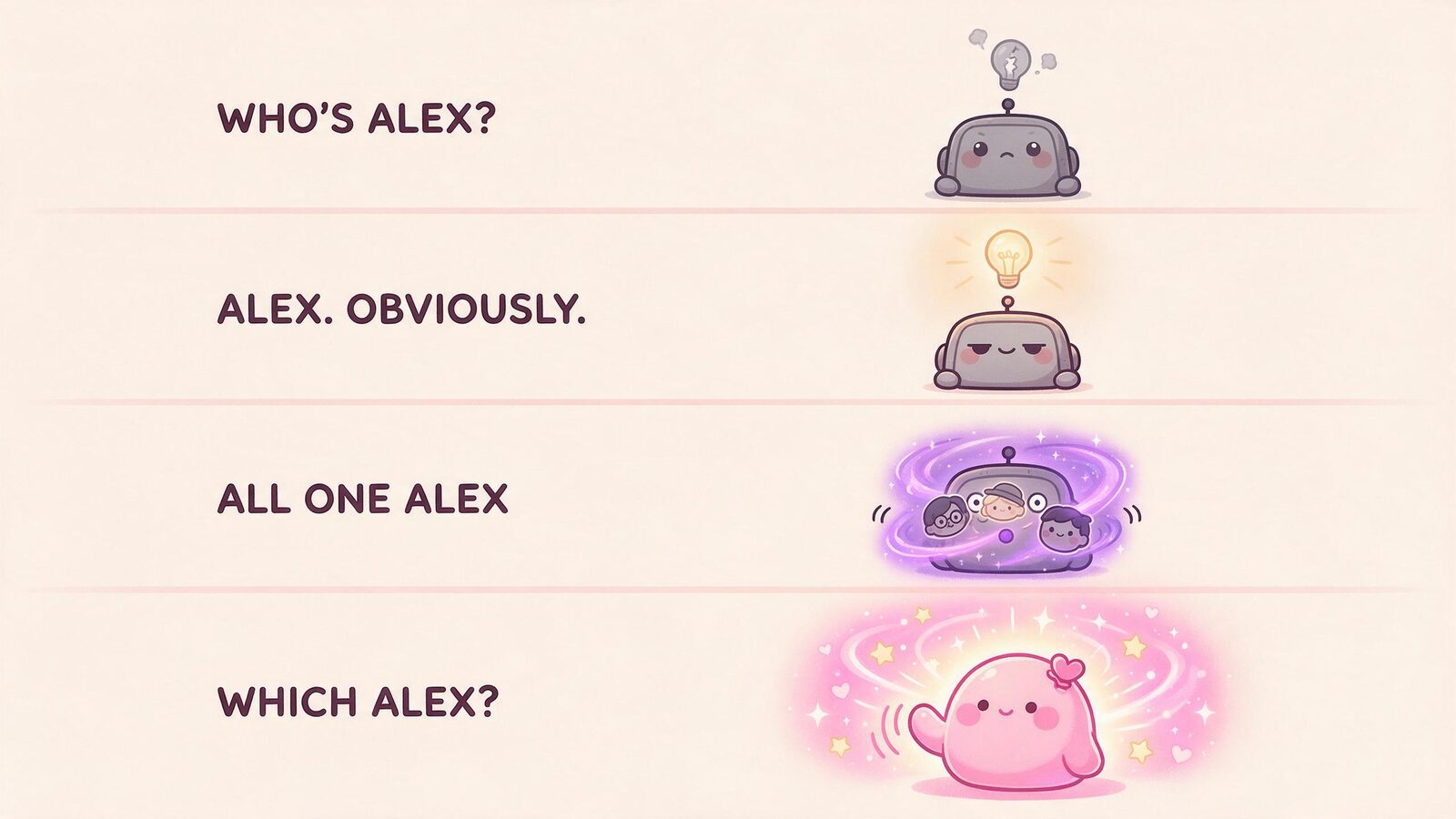
In a hypothetical example, imagine you mention "Alex" in three separate conversations over two weeks. In the first, Alex is your coworker who keeps stealing your lunch. In the second, Alex is your college friend visiting from out of town. In the third, you're venting about your ex, who is also named Alex.
A system might store several mentions labeled “Alex,” combine them incorrectly, or keep them separate. Resolving the ambiguity means determining whether these are the same person or three different people, and keeping the relevant details separate when they refer to different people. That disambiguation step is non-trivial. It requires the system to weigh contextual signals: job references, emotional tone, timeline, and any explicit clarifications you offered.
Related research helps explain why time and connections deserve attention. LoCoMo evaluates long conversations, including questions and event summaries, and reports difficulties with temporal and causal relationships. That is broader evidence about conversational context, not a specific test of our three-Alex example or of Kissable.
What a Relational Record Could Contain
People are only one kind of information a system can connect. The table below describes possible information categories and the ambiguities a reader can watch for. It does not describe a verified database shared by all apps.
| Entity type | What a companion might store | Where ambiguity arises |
|---|---|---|
| Person (named) | Name, relationship role, emotional valence, key facts | Same name, multiple people; role changes over time |
| Place (named) | Location label, associated events or feelings | Moved away; place carries new meaning after an event |
| Relationship status | "Close friend," "ex," "coworker" | Status changes; user may not announce the update |
| Shared history | Specific events, inside jokes, recurring topics | Events reinterpreted; user perspective shifts |
| Emotional associations | Positive, negative, complicated, neutral | Feelings evolve; contradiction across sessions |
| Pets and objects | Names, descriptions, significance | Pet passes away; object has new sentimental weight |
Note: What any specific app stores depends on its implementation. This table describes categories that relational memory systems can, in principle, track. It is not a guarantee of what every companion app does.
The right column is the one worth paying attention to. Each category carries a version of the same problem: the information was accurate when first captured, but life moves. A companion that treats its stored facts as permanent ground truth will eventually say something that feels wrong, not because it forgot, but because it never learned that things changed.
When a Clarifying Question Is the Better Answer
There is a counterintuitive design principle worth naming: a companion that occasionally says "I'm not sure if this is still the case, but you mentioned..." is often more trustworthy than one that states everything with equal confidence.
An appropriately qualified answer makes room for correction. The phrase “I’m not sure” alone does not establish that a system has accurately assessed its limits. It invites you to correct the record rather than leaving a wrong assumption unchallenged. It also mirrors how real relationships work. A friend who has not seen you in six months will ask whether you are still at the same job rather than assuming you are. That checking-in behavior feels respectful, not incompetent.
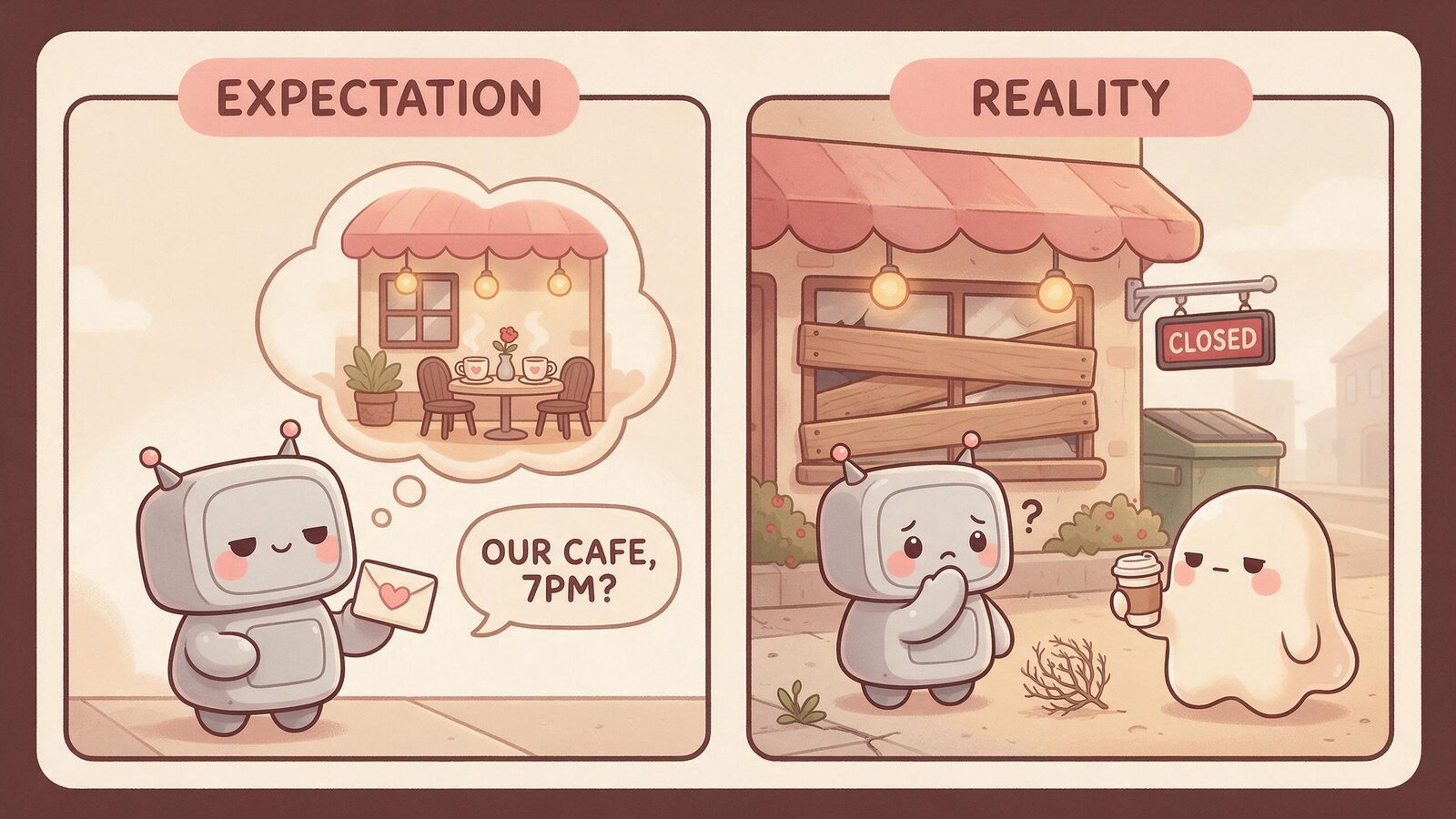
The alternative, a companion that asserts outdated facts with full confidence, creates a specific kind of friction. It does not feel like the companion forgot. It feels like the companion was not paying attention, which is a worse impression.
The practical implication: When you introduce a new detail that contradicts something your companion previously stored, the best response is an update, not a contradiction. "Oh, I thought you and Jordan were still close" followed by an accurate adjustment is better than either ignoring the update or pretending the previous information never existed.
For users, this suggests a simple habit: when something significant changes in your life, mention it explicitly. Do not assume your companion will infer the update from context. A direct statement gives the system the clearest possible signal to work with. You can read more about how memory structures work in practice in this guide to AI lorebooks and memory systems.
Keep the Source and the Timeline
Consider this fictional record:
| Detail | Source | When it applies | What remains uncertain |
|---|---|---|---|
| Alex is the user’s coworker | Explicit introduction | Current in the story | Whether Alex is also a friend |
| The Blue Room is at the office | Explicit statement | Current in the story | Its address was never given |
| Alex booked the Blue Room | Reported event | For Thursday’s workshop | Whether the booking later changed |
| Alex and the user are close | An inference from friendly wording | Unconfirmed | The user never described the relationship that way |
A useful response should not silently upgrade the last row into a confirmed fact. A user’s statement, a character’s invented story detail, and a system’s inference have different origins.
The vendor-authored Zep paper describes a temporal knowledge graph for agent memory. Graphs are one way to represent connections and historical relationships. They do not automatically resolve ambiguous names, prevent extraction mistakes, or guarantee better answers than another architecture. That paper did not evaluate Kissable.
For readers, the practical question is whether the reply uses the correct relationship and timing. The label on the storage system is not enough to answer it.
A Quick Self-Check for Any AI Companion App
If you want to test the relational memory quality of any companion app, including the one you currently use, these hypothetical checks can help you observe specific behaviors. Use fictional details and record the statements and replies:
- Name collision test. Mention two different people with the same first name in separate conversations. Later, ask your companion about that name. Does it ask for clarification, or does it confidently blend the two people together?
- Relationship update test. Tell your companion that a relationship has changed ("Sam and I aren't really close anymore"). A week later, reference Sam. Does the companion reflect the update, or does it revert to the earlier description?
- Place association test. Describe a place with emotional context ("I used to love going to that coffee shop, but it closed"). Later, mention the place again. Does the companion remember the past tense, or does it treat the place as still active?
- Inference confidence test. Let the companion infer something from context without stating it directly. Then ask it about that inferred fact. Does it present the inference as certain, or does it indicate that it is working from an assumption?
Define the expected answer where the facts are explicit. Where the information is ambiguous, look for a suitable clarification rather than a confident guess. A single result describes that exchange; repeat important checks and keep the original failures in your notes.
Frequently Asked Questions
Does my AI companion remember everyone I mention, or only people I introduce formally?
It depends on what the app extracts, retains, and supplies to later responses. Mentioning a name does not guarantee that it becomes a durable memory. An explicit introduction removes some ambiguity; a later question lets you check what the companion can recall.
What happens if I mention the same name for two different people?
This depends on the system. A basic memory implementation may merge them into a single entry, which can produce confusing responses later. A more sophisticated relational memory system will flag the ambiguity, either by asking for clarification or by maintaining two separate entries with a note that they share a name. If you notice your companion seems confused about a name, a direct correction ("just to clarify, there are two people named Alex in my life") is a useful first step.
Can my companion remember that a relationship ended or changed?
It may, if the change is available in its context and used correctly. AI companions cannot observe your life independently. If a friendship cooled, a relationship ended, or someone moved away, your companion will only know if you mention it. Stating the change clearly makes it possible to check whether later answers use the updated relationship.
Is the information my companion stores about my friends and family private?
Check the app’s privacy information and available data controls before sharing personal details. Use invented examples when comparing memory features. A convenient memory interface is not, by itself, evidence of a particular retention or deletion policy.
Does my companion actually understand the meaning of relationships, or just store labels?
Current AI systems do not understand relationships the way humans do. What they can do is use relationship labels and associated context to generate responses that are more appropriate to the dynamic you described. "My ex" and "my close friend" will produce meaningfully different responses to the same question, because the system uses those labels to shape its output. That is not deep understanding, but it is more than just storing a name.
Kissable uses persistent context to support ongoing conversations with a fictional companion. Test whether it distinguishes the people and places in your examples, acknowledges missing information, and handles a relationship update accurately. These are observable checks, not promises of perfect memory or a particular editable interface.
For the broader picture, read how companion recall works and our guide to comparing memory features.
Start a conversation on Kissable and try a clearly labeled fictional example with two people called Alex.
AI Research Writer
Maya covers AI companion technology, safety, and the psychology behind human-AI relationships. She focuses on what the research actually says, and what it doesn’t.